

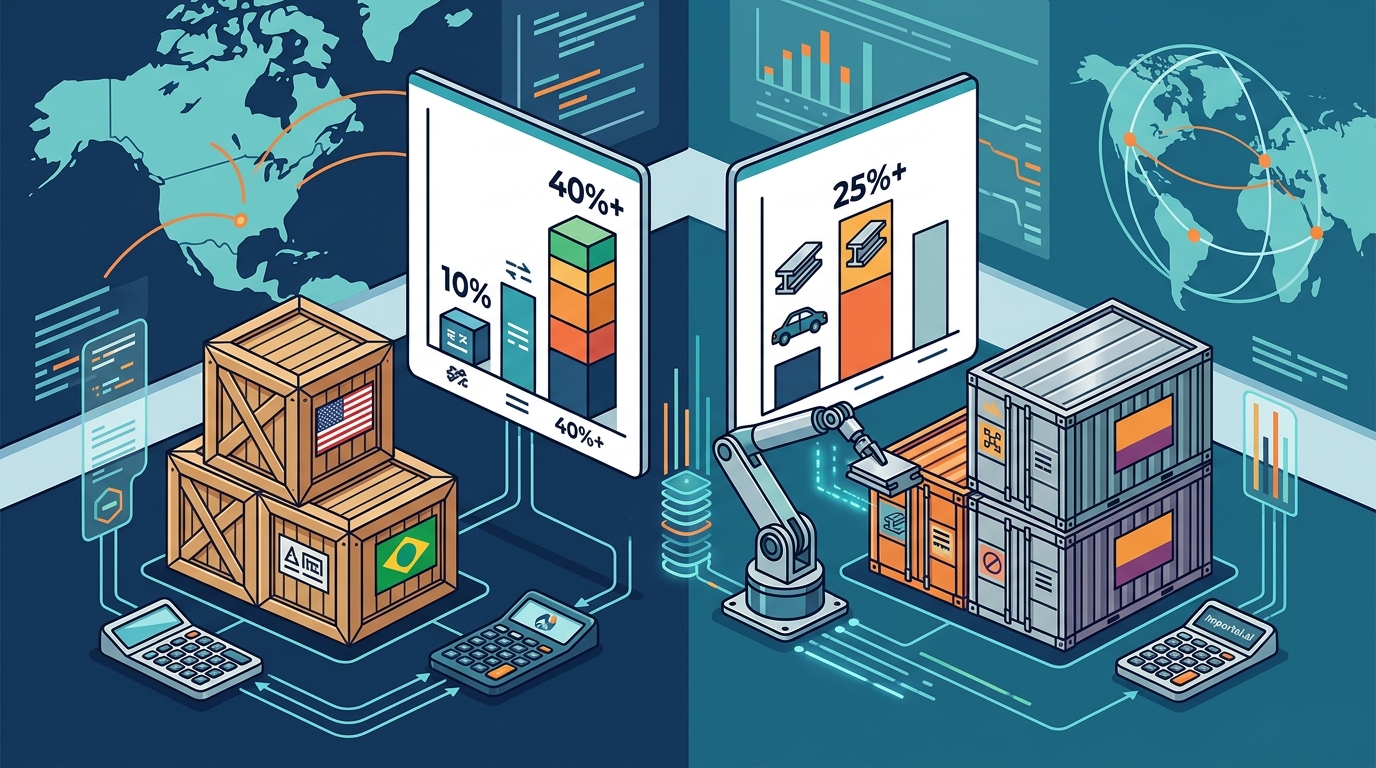
Choosing the right sourcing country is not just about unit price. In 2026, U.S. importers face a multi-layered tariff environment with baseline rates of 10%, reciprocal surcharges reaching over 40%, and sector-specific duties of 25% or more on steel, aluminum, and automobiles. A product that looks affordable from one country can become uncompetitive once duties, taxes, and fees are factored in. This guide walks you through exactly how to compare duties and tariffs across countries before you commit to a supplier, so you can make sourcing decisions based on total landed cost rather than guesswork.
Why Comparing Tariffs Before Sourcing Matters
Purchase price is only part of total cost. True landed cost incorporates duties, transportation, insurance, handling, and other fees. When you skip the tariff comparison step, you risk selecting a supplier that appears cheap but becomes expensive once regulatory costs are included.
The 2026 U.S. tariff landscape is especially complex. China faces the highest tariff burden of any U.S. trading partner, with combined Section 301 duties and reciprocal surcharges stacking on top of base rates. Meanwhile, countries with active free trade agreements may offer duty-free or reduced-rate entry for qualifying goods. Comparing duties upfront lets you identify these savings before signing a purchase order.
Key Terms You Need to Know
Landed Cost
Landed cost is the total expense of getting a product from a foreign supplier to your warehouse, including purchase price, freight, insurance, customs duties, taxes, and fees. Calculating it accurately is essential for profitable sourcing.
HTS Code
An HTS code is a numerical classification assigned to every imported product that determines its applicable duty rate. The Harmonized System is standard up to six digits internationally, which is the most detailed level that can be compared across countries. Accurate HTS classification is the foundation of any tariff comparison.
Most Favored Nation (MFN) Rate
The MFN tariff rate is the standard duty rate that WTO member countries impose on imports from other WTO members unless a preferential trade agreement applies. It serves as the baseline for comparison.
Step-by-Step: How to Compare Duties Across Countries
1. Classify Your Product Correctly
Start by identifying the correct 6-digit HS code for your product. This code is the key to unlocking accurate duty rates in every country. Use Importal's Product Library to search and validate classifications with AI-powered suggestions.
2. Pull Duty Rates for Each Sourcing Country
Once you have your HS code, look up the applicable duty rate for each potential country of origin. Rates vary dramatically. For example, a cotton t-shirt imported from a country with a preferential trade agreement may enter at 0%, while the same product from a high-tariff country could face 20% or more. Use Importal's Country Comparison tool to see side-by-side duty breakdowns instantly.
3. Factor in Additional Duties and Fees
Do not stop at the base tariff. Layer in Section 301 duties, Section 232 duties (for steel, aluminum, and automobiles), anti-dumping or countervailing duties, merchandise processing fees, and harbor maintenance fees. These can double or triple the effective rate. Importal's Duty Calculator Pro accounts for all of these automatically.
Tools and Databases for Tariff Comparison
Several authoritative resources exist for looking up duty rates by country. The WTO Tariff & Trade Data platform aggregates official applied tariffs and bound rates from WTO members across over 170 countries. The U.S. International Trade Commission maintains the official Harmonized Tariff Schedule for U.S. imports.
For importers who need real-time, product-specific comparisons rather than raw data lookups, platforms like Importal combine automated tariff calculations, import license tracking, and country comparisons in one dashboard. Importal's API can also plug directly into your ERP or purchasing system to deliver live tariff data as purchase orders are created.
Sample Tariff Comparison Table
The table below illustrates how effective duty rates can differ for the same product imported from different countries into the United States in 2026.
| Country of Origin | Base MFN Duty | Reciprocal / Additional Tariff | Estimated Effective Rate | FTA Eligible? |
|---|---|---|---|---|
| China | 7.5% | Section 301 + Reciprocal (~30-50%) | 37.5-57.5% | No |
| Vietnam | 7.5% | Reciprocal (~10-25%) | 17.5-32.5% | No |
| Mexico | 7.5% | USMCA: 0% if qualifying | 0-7.5% | Yes (USMCA) |
| India | 7.5% | Reciprocal (~10-26%) | 17.5-33.5% | No |
| South Korea | 7.5% | KORUS FTA: 0% if qualifying | 0-7.5% | Yes (KORUS) |
Note: Rates are illustrative and vary by HTS code. Always verify with current tariff schedules.
Leveraging Free Trade Agreements
The United States has free trade agreements with more than 20 countries. Targeting FTA countries is a competitive sourcing strategy because goods that meet rules of origin requirements can enter at reduced or zero duty rates. The USMCA agreement, for instance, eliminates tariffs on most qualifying products traded between the U.S., Canada, and Mexico.
However, qualifying for preferential treatment requires maintaining detailed origin documentation, including supplier declarations, manufacturing records, and cost breakdowns. A platform like Importal helps you track these requirements alongside your tariff reduction strategies so nothing falls through the cracks.
Key Takeaways
- Always compare total landed cost, not just unit price, when evaluating sourcing countries.
- Accurate HTS classification is the single most important step in any tariff comparison.
- Layer in Section 301, Section 232, anti-dumping duties, and fees beyond the base MFN rate.
- Free trade agreements can reduce duties to zero for qualifying products from partner countries.
- Use real-time tools rather than static spreadsheets to keep up with rapidly changing tariff rules.
- Country-of-origin rules are strict. Transshipment through a third country does not change tariff treatment.
- Automate duty calculations in your ERP or purchasing workflow to catch cost changes before committing to orders.
Frequently Asked Questions
What is the easiest way to compare tariffs across countries?
The fastest method is using a tariff comparison platform that lets you enter your product's HS code and instantly see duty rates by country of origin. Importal's Country Comparison tool does exactly this, showing side-by-side breakdowns including additional tariffs and fees.
Do I need a different HS code for each country?
No. The Harmonized System is standardized at the 6-digit level across all WTO member countries. However, countries add additional digits for national tariff lines, so the duty rate at the detailed level varies by destination.
How often do tariff rates change?
Tariff rates can change frequently. In 2025 and 2026, U.S. tariff policy shifted multiple times through executive orders, Section 232 proclamations, and new Section 301 investigations. Real-time monitoring is essential.
What is landed cost and why does it matter for sourcing?
Landed cost is the total cost of a product delivered to your door, including purchase price, shipping, insurance, customs duties, taxes, and handling fees. Failing to calculate it accurately can erode profit margins and make a seemingly affordable product too costly to import.
Can free trade agreements eliminate duties entirely?
Yes. If your product qualifies under a free trade agreement's rules of origin, it can enter the United States at a zero percent duty rate. The USMCA, KORUS FTA, and other agreements each have specific qualification criteria.
What are Section 301 and Section 232 duties?
Section 301 duties are additional tariffs imposed on products from countries found to engage in unfair trade practices, most notably China. Section 232 duties are tariffs applied to specific sectors like steel and aluminum based on national security grounds. Both stack on top of standard MFN rates.
How does Importal help with tariff comparison?
Importal provides automated tariff calculations, country comparisons, and product data in one dashboard. The platform updates automatically when tariffs change, so your sourcing decisions always reflect current rates. You can also connect Importal's API to your ERP for real-time landed cost data at purchase order creation.
What happens if I classify my product incorrectly?
Misclassification can lead to overpaying duties, underpaying duties (which triggers penalties and audits from CBP), or delays at customs. Getting the HTS code right from the start is critical for accurate tariff comparisons and compliance.
Start Comparing Tariffs Today
Stop guessing which sourcing country gives you the best total cost. Schedule a demo with Importal and see how automated tariff calculations, country comparisons, and real-time compliance tools can help you make smarter purchasing decisions before your next order ships.