

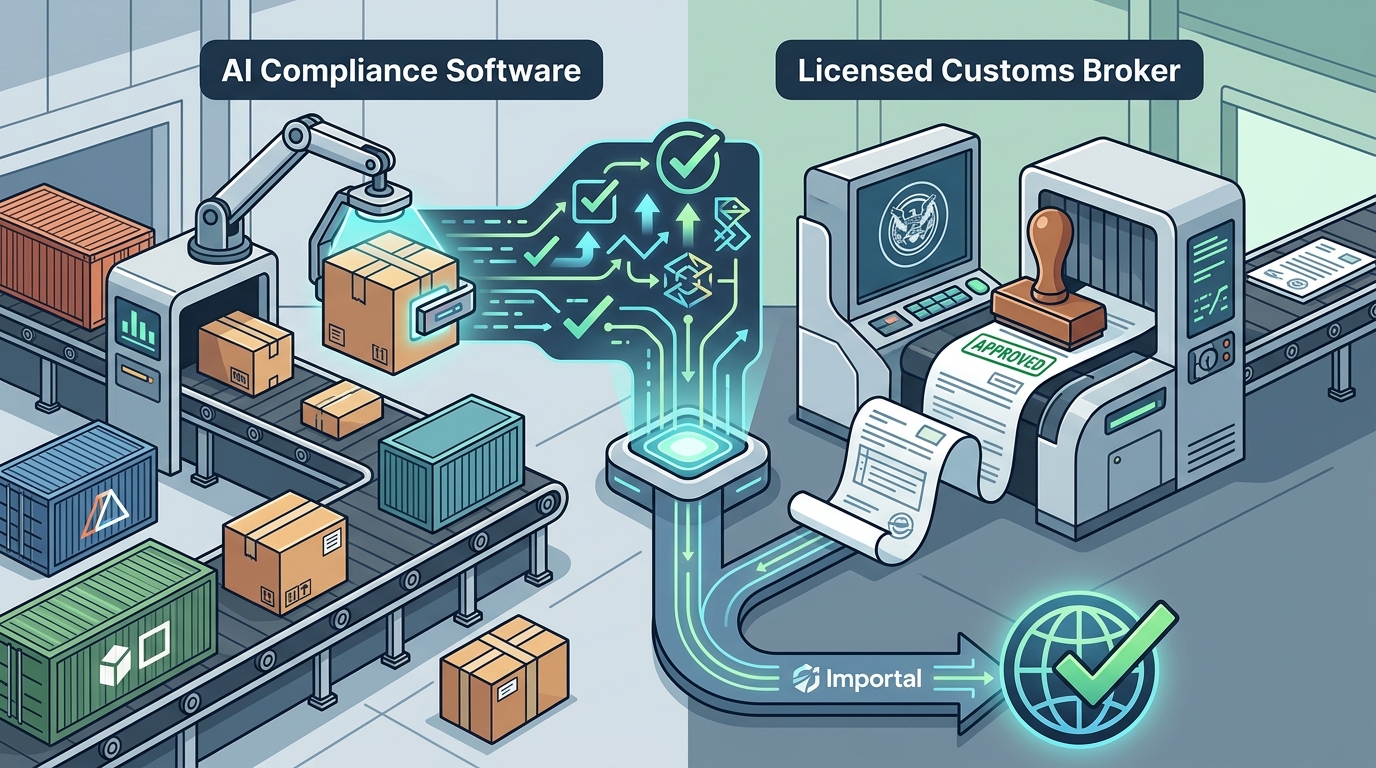
For years, importers had to choose between two separate worlds: trade compliance software on one side and a licensed customs broker on the other. Software platforms could classify products and calculate duties, but they could not legally file entries with U.S. Customs and Border Protection (CBP). Brokers could file entries, but most relied on manual processes, spreadsheets, and outdated systems. Today, a new category of platform combines both capabilities under one roof, and it is changing how importers manage compliance in a volatile tariff environment.
Why the Gap Between Software and Brokerage Exists
The customs brokerage industry is regulated by 19 U.S.C. § 1641, which requires anyone conducting "customs business" on behalf of an importer to hold a valid customs broker license issued by CBP. This means that no matter how sophisticated a piece of software is, it cannot legally file an entry or provide binding HTS classifications for specific goods intended for importation unless a licensed broker is involved.
Most trade compliance software companies operate as technology vendors. They build tools for classification research, duty calculation, or document management. But they do not hold broker licenses, so importers must still hire a separate brokerage to actually clear goods through customs.
This creates a fragmented workflow: the importer pays for software, pays a broker, and then spends time bridging the gap between both systems manually.
What a Licensed Customs Broker Actually Means
A licensed customs broker is an individual or entity authorized by CBP to transact customs business on behalf of importers. Brokers must pass a rigorous federal examination, undergo background checks, and maintain compliance with 19 CFR Part 111, which governs broker responsibilities including supervision, recordkeeping, and professional conduct.
Brokers are legally responsible for the accuracy of entries they file. They must exercise "reasonable care" under 19 U.S.C. § 1484, which means verifying classifications, valuations, and country-of-origin declarations before submitting data to CBP. This accountability is why broker involvement is not optional for most importers.
Why Broker Quality Varies
Not all brokerages invest in technology. Many still rely on manual CSMS message tracking, Federal Register monitoring, and spreadsheet-based workflows. When tariff policy changes as frequently as it has in 2025 and 2026, manual processes create errors. One audit found an average error rate of 20% on entries filed by outside brokers, meaning one in five entries contained a mistake.
What AI Compliance Software Does
AI compliance software is a category of trade technology that uses artificial intelligence to automate classification, duty calculation, regulatory monitoring, and entry validation. These platforms typically ingest product data, apply machine learning models trained on tariff schedules and trade rulings, and output HTS code suggestions, landed cost estimates, or compliance alerts.
Common AI Compliance Capabilities
Most platforms in this space offer some combination of HTS classification assistance, duty and fee calculations, real-time tariff monitoring, and document extraction. Some add features like country-of-origin comparison tools or partner government agency (PGA) screening.
The Limitation of Software Alone
Software-only platforms cannot file entries, cannot serve as the broker of record, and cannot take legal responsibility for compliance. As CBP clarified in Ruling HQ H290535, providing HTS classifications beyond six digits for specific goods intended for importation constitutes customs business and requires a licensed broker.
Why Combining Both Matters Now More Than Ever
The U.S. tariff environment has become extraordinarily complex. Section 232 tariffs changed multiple times. IEEPA tariffs were struck down by the Supreme Court in February 2026. Section 301 investigations expanded to 16 economies. Section 122 replaced IEEPA tariffs within hours. Chapter 99 codes shifted on a near-weekly basis throughout 2025.
In this environment, the broker who files your entry needs real-time compliance intelligence at the moment of filing, not days later. A platform that combines AI compliance tools with licensed brokerage services eliminates the gap between knowing and doing. The same system that monitors regulatory changes also applies those changes to your entries before they are submitted to CBP.
Traditional Brokers vs. AI-Powered Brokerage Platforms
| Capability | Traditional Broker | AI-Powered Brokerage Platform |
|---|---|---|
| Entry filing with CBP | Yes | Yes |
| Licensed customs broker on staff | Yes | Yes |
| Real-time tariff monitoring | Manual (CSMS, Federal Register) | Automated, system-level |
| AI-powered HTS classification | Rare | Built in |
| Duty calculation with live tariff rates | Spreadsheet-based | Automated with current rates |
| Pre-filing compliance validation | Depends on broker | Automated before every entry |
| Regulatory change applied to entries | Hours or days after publication | Flagged before entry filing |
| Audit-ready documentation | Varies | Structured and searchable |
The difference is not just speed. It is accuracy at scale. When Section 232 rates change or new exclusions take effect, an AI-powered brokerage platform flags the update before the entry gets filed, not after CBP liquidates it incorrectly.
How Importal Combines AI and Licensed Brokerage
Importal is the first AI-powered licensed U.S. customs brokerage. The platform tracks every regulatory change in real time and surfaces compliance data directly to licensed brokers during entry filing. This means the same system that monitors tariff shifts also ensures those changes are reflected in your entries before submission.
What the Platform Includes
Importal offers complete customs clearance services including ISF filings, entry processing, and customs bonds. The compliance tools include AI-powered classification, a duty calculator, and real-time regulatory alerts. Every feature is connected to the brokerage workflow, so nothing falls through the cracks between classification and filing.
Why This Architecture Matters
Traditional brokers are manually tracking CSMS messages, Federal Register notices, and executive orders. They update spreadsheets and hope they catch everything. Importal's platform does that work in real time and surfaces it directly to licensed brokers during entry filing. The result is fewer errors, faster clearance, and better compliance outcomes for importers navigating today's tariff volatility.
Key Takeaways
- A licensed customs broker is legally required to file entries with CBP on behalf of importers under 19 U.S.C. § 1641.
- AI compliance software automates classification, duty calculation, and tariff monitoring but cannot legally file entries alone.
- Combining both in one platform eliminates the gap between compliance intelligence and entry filing.
- The 2025-2026 tariff environment, with frequent Section 232, 301, and IEEPA changes, makes real-time compliance critical.
- Importal is the first AI-powered licensed U.S. customs brokerage, combining automated compliance tools with licensed broker expertise.
- An audit found a 20% error rate on entries filed by brokers using manual processes, underscoring the value of AI-assisted validation.
- Pre-filing compliance checks catch classification and tariff errors before they reach CBP, reducing audit risk and refund delays.
Frequently Asked Questions
Can AI software replace a licensed customs broker?
No. Under 19 U.S.C. § 1641, only a licensed customs broker can conduct customs business on behalf of an importer. AI software can assist with classification and compliance research, but a licensed broker must review and file all entries with CBP.
What is an AI-powered customs brokerage?
An AI-powered customs brokerage is a platform that combines artificial intelligence tools for classification, duty calculation, and regulatory monitoring with licensed customs broker services for entry filing and compliance. Importal is an example of this model.
Why do importers need real-time tariff monitoring?
Tariff rates, exclusions, and Chapter 99 codes have changed frequently throughout 2025 and 2026. Without real-time monitoring, brokers risk filing entries at incorrect duty rates, which can trigger CBP audits, penalties, or delayed refunds.
Does Importal hold a U.S. customs broker license?
Yes. Importal operates as a licensed U.S. customs brokerage based in Texas. The platform combines AI-powered compliance tools with licensed broker oversight for every entry filed.
How does AI improve HTS classification accuracy?
AI models trained on tariff schedules, CBP rulings, and product data can suggest HTS codes faster and more consistently than manual research. When integrated into the brokerage workflow, these suggestions are validated by licensed brokers before filing, reducing the error rate significantly.
What services does Importal offer beyond customs clearance?
Importal provides ISF filings, customs bonds, duty calculations, AI-powered HTS classification, regulatory monitoring, and a full knowledge hub with compliance guides and trade policy updates.
Is there a risk to using AI tools for customs compliance?
AI tools carry risk only when used without proper broker oversight. CBP has emphasized that responsible supervision and control remain the broker's obligation. Platforms that embed AI within a licensed brokerage workflow mitigate this risk by keeping a qualified human in the loop for every filing decision.
How do I get started with an AI-powered customs broker?
You can request a demo from Importal to see how the platform handles classification, compliance monitoring, and entry filing in a single workflow.
Ready to Simplify Your Imports?
Stop juggling separate software tools and brokerage relationships. Importal brings AI compliance intelligence and licensed customs brokerage together in one platform. Talk to a licensed broker today and see how Importal can reduce errors, speed up clearance, and keep your supply chain compliant.