

Replace Outdated Customs Entry Processes With AI Automation
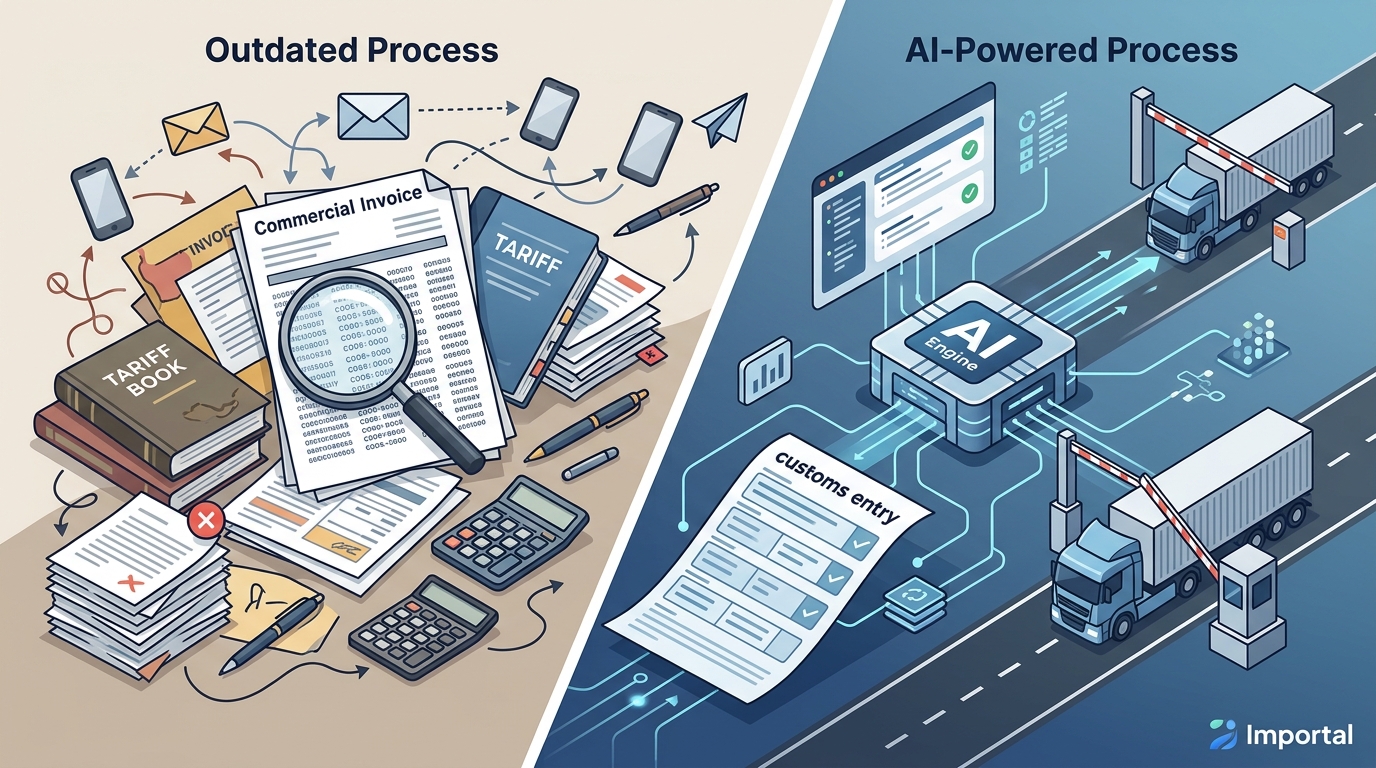
Manual customs entry is one of the last holdouts of paper-heavy, error-prone workflows in global trade. Importers, brokers, and freight forwarders still spend hours re-keying data from commercial invoices, cross-referencing tariff schedules by hand, and chasing down missing documents across email threads. The result is predictable: delays at the border, compliance penalties, and rising operational costs. A customs entry process is the formal procedure by which an importer declares goods to a country's customs authority, providing product details, classification codes, and duty calculations. This guide explains exactly what is broken, what modern alternatives look like, and how AI-powered platforms like Importal are replacing legacy workflows with intelligent automation.
Why Manual Customs Entry Processes Fail
Most customs clearance systems still in use were built before the era of cloud infrastructure and API connectivity. Many organizations continue to rely on spreadsheets, faxed documents, and siloed data entry across departments. Customs paperwork is frequently assembled from procurement, logistics, and sales teams, creating inconsistent values between declarations and invoices.
Manual processes are inherently slower and more resource-intensive compared to automation, leading to delays and inefficiencies in customs operations. When brokers manually track regulatory changes through CSMS messages and Federal Register notices, errors are inevitable. The sheer volume of tariff updates in 2025 and 2026 has made manual tracking nearly impossible to sustain.
The Real Cost of Data Entry Errors
A manual data entry error is not just an inconvenience. Common mistakes include incorrect product descriptions, wrong tariff codes, and missing quantities. These errors cause non-compliant documentation that can trigger penalties, shipment holds, and full CBP audits.
Error Rates Are Higher Than You Think
Manual entry leads to a 15-20% error rate in logistics documentation. A single manual data entry error can cost a company an average of $4.70 per entry, and those charges accumulate rapidly across thousands of shipments per year.
Downstream Consequences
Inaccurate data entry can lead to non-compliance with customs regulations, resulting in delays, penalties, and reputational damage. For U.S. importers, misclassifying a product under the wrong HTS code means either overpaying duties or facing penalties for underpaying. These are not abstract risks. They affect cash flow, delivery timelines, and customer trust.
What Modern Customs Automation Looks Like
Customs automation is the use of software to replace manual data entry, document assembly, and compliance verification with intelligent, rules-based workflows. Modern platforms connect directly to government systems like the U.S. Automated Commercial Environment (ACE) and the Automated Broker Interface (ABI), auto-generating customs forms from transaction data.
Importal's trade compliance platform combines automated compliance tools with licensed customs brokerage. The platform tracks every regulatory change in real time. When tariffs change, it catches them and applies updates to entries automatically, so licensed brokers have the right compliance data at their fingertips when filing.
Document Intelligence
AI-powered software automatically extracts and processes goods data from electronic trade documents, reducing the risk of human error during data entry. Platforms pull invoice data, purchase orders, and shipping documents, then transform that information into the exact format each customs authority requires. Instead of re-keying data across systems, importers can manage everything through a single import services dashboard.
AI-Powered HTS Classification
HTS classification is the process of assigning standardized tariff codes to imported goods based on their material, function, and intended use. Getting classification wrong is one of the most expensive compliance mistakes an importer can make.
Importal's compliance tools use AI to analyze product attributes and match them to the correct codes in the U.S. tariff schedule. This reduces the risk of misclassification that leads to overpaid duties or CBP scrutiny. Unlike static lookup tables, AI-driven classification adapts as tariff codes change, which has been happening at an unprecedented pace.
Product Library for Ongoing Accuracy
Importal's Product Library lets importers store classified products so every future shipment uses validated HTS codes. This eliminates the need to reclassify the same goods manually with each new entry.
Manual vs. Automated: Side-by-Side Comparison
| Capability | Manual Process | AI-Automated Platform |
|---|---|---|
| Data entry speed | 30-60 min per entry | Minutes or less |
| Error rate | 15-20% | Under 2% |
| Tariff update tracking | Manual review of Federal Register | Real-time automated alerts |
| HTS classification | Broker lookup and manual assignment | AI-driven, confidence-scored |
| Document formatting | Re-keyed across systems | Auto-generated from source data |
| Compliance audit trail | Scattered across email and spreadsheets | Centralized, timestamped logs |
| Scalability | Requires adding headcount | Handles volume without staffing changes |
Rising Regulatory Pressure Makes Automation Urgent
The U.S. trade enforcement landscape has intensified significantly. The FY2027 White House budget proposal requests a 45% funding increase for USTR and an additional $136 million for CBP to modernize ACE. The Bureau of Industry and Security would see its budget nearly double. This signals that classification errors, valuation discrepancies, and origin misstatements will receive more scrutiny, not less.
Section 232 tariffs have changed multiple times. IEEPA tariffs were struck down by the Supreme Court. Section 301 investigations have expanded to sixteen economies. Every one of these changes hits entries, classifications, and duty rates in real time. Brokers who are manually tracking all of this are missing things. Platforms like Importal that surface regulatory changes directly during entry filing give importers a structural advantage. Learn more in the Importal Knowledge Hub.
Key Takeaways
- Manual customs entry processes carry a 15-20% error rate and cost businesses thousands per year in avoidable penalties and overpaid duties.
- Customs automation is the use of software to replace manual data entry, document assembly, and compliance checks with intelligent workflows.
- AI-powered HTS classification eliminates the most expensive and common compliance mistake importers make.
- Real-time regulatory tracking is no longer optional given the pace of tariff changes in 2025 and 2026.
- The U.S. government is investing heavily in trade enforcement infrastructure, making accurate entry filing more important than ever.
- Centralized platforms with audit trails protect importers during CBP reviews and refund processes like CAPE.
- Importal combines AI automation with licensed customs brokerage to deliver compliance-ready entries from a single platform.
Frequently Asked Questions
What is a customs entry process?
A customs entry process is the formal procedure by which an importer declares goods to a country's customs authority. It includes submitting product descriptions, HTS classification codes, declared values, country of origin, and duty calculations to systems like the U.S. Automated Commercial Environment (ACE).
Why are manual customs processes still so common?
Many customs clearance systems were built before cloud infrastructure existed. Organizations have been slow to migrate because of the perceived cost and complexity of switching platforms. However, the pace of regulatory change is now making manual processes unsustainable.
How does AI improve HTS classification accuracy?
AI analyzes product attributes such as material composition, function, and intended use, then matches them against the tariff schedule. Unlike manual lookup, AI adapts in real time as codes change and can assign confidence scores to each classification.
What is ACE in U.S. customs?
ACE (Automated Commercial Environment) is the primary system through which U.S. importers and brokers submit electronic customs declarations to CBP. It replaced older paper-based filing methods and is central to modern customs automation.
How much do manual data entry errors cost?
Research shows a single manual data entry error costs an average of $4.70 per entry. Across thousands of annual shipments, this adds up to significant financial exposure, not counting penalties, delays, or audit costs.
Can small importers benefit from customs automation?
Absolutely. Smaller businesses often benefit the most from the cost savings and efficiency improvements that automation provides. Platforms like Importal are designed to serve importers of every size and experience level.
What makes Importal different from traditional customs brokers?
Importal is the first AI-powered licensed U.S. customs brokerage. The platform tracks regulatory changes in real time and surfaces compliance data directly to licensed brokers during entry filing, rather than relying on manual spreadsheet tracking.
How do I get started replacing manual customs entry workflows?
The fastest path is to schedule a demo with Importal. The platform covers customs clearance, HTS classification, duty calculations, bonds, and ISF filings from a single dashboard.
Replace Your Outdated Customs Workflows Today
Manual customs entry is a liability your business does not need to carry. Importal gives you AI-powered compliance tools, licensed customs brokerage, and real-time regulatory tracking on one platform. Schedule a free demo and see how modern importers are clearing goods faster, more accurately, and with far less manual work.