

Managing import documentation manually is one of the biggest time drains in international trade. Between commercial invoices, packing lists, bills of lading, entry summaries, and certificates of origin, a single shipment can involve a dozen or more documents that all need to be accurate and filed on time. U.S. Customs and Border Protection requires entry documents within 15 calendar days of a shipment's arrival, and an entry summary (CBP Form 7501) must be filed within 10 working days after entry. One error can mean delays, penalties, or a full audit. The good news: modern automation tools can handle much of this work faster and more accurately than any spreadsheet ever could.
What Is Customs Documentation Automation?
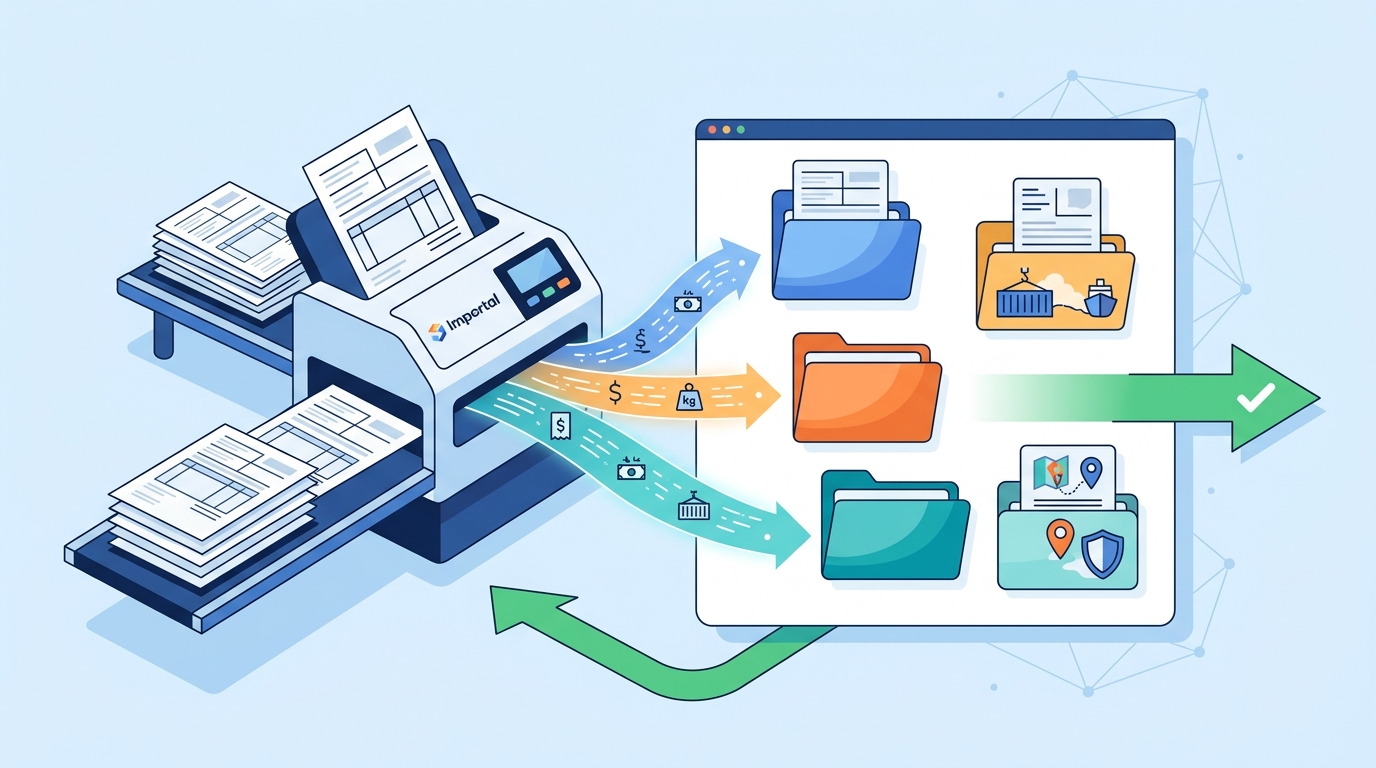
Customs documentation automation is the use of technology to extract data from trade documents, validate it against regulatory requirements, and prepare customs filings with minimal manual intervention. Instead of a compliance team manually keying invoice data into entry forms, an automated platform pulls the relevant fields, cross-references HTS codes and tariff databases, and flags discrepancies before anything is submitted to CBP.
The Automated Commercial Environment (ACE) is the United States's centralized digital system for processing imports and exports. Every electronic import manifest and entry summary must be filed through ACE. Automation platforms connect directly to ACE or work through the Automated Broker Interface (ABI), ensuring your filings reach CBP in the correct format every time.
Why Manual Customs Paperwork Fails at Scale
Manual customs processing relies on copying and pasting data between trade documents and government forms. This approach introduces errors at every step. AI-powered document processing solutions have been shown to reduce documentation processing time by up to 80% compared to manual methods, while also lowering per-document costs from $5 to $10 down to pennies.
The Real Cost of Errors
Classification mistakes, valuation discrepancies, and incorrect country-of-origin declarations do not just delay your shipment. They can trigger a CBP audit. As Importal's compliance team has documented, brokers who manually track regulatory changes are missing things in the current tariff environment. The velocity of change in 2025 and 2026 has made manual tracking nearly impossible.
Regulatory Complexity Is Growing
The FY2027 federal budget proposal includes a 45% funding increase for USTR and an additional $136 million for CBP to modernize ACE. More enforcement capacity means more scrutiny on every entry. If your documentation workflow still depends on spreadsheets, the risk grows with every shipment. Staying current with trade compliance updates is essential.
Core Import Documents You Should Automate
Standard customs clearance requires several documents that are prime candidates for automation. A commercial invoice is the primary record of the transaction between buyer and seller. A packing list is a detailed breakdown of the contents, weight, and dimensions of each package in a shipment. A bill of lading is the contract between the shipper and carrier that serves as a receipt for goods and title document.
Beyond the Basics
Depending on the product and destination country, you may also need certificates of origin, phytosanitary certificates, customs bonds, ISF filings, and Partner Government Agency (PGA) data. Automating all of these together, rather than one at a time, is where the real efficiency gains happen. Platforms like Importal's compliance platform handle this end-to-end.
How AI Automates Customs Documentation Step by Step
Step 1: Data Extraction
AI-powered document processing extracts shipment details, customs classifications, and invoice data from PDFs, images, and structured files. Modern systems achieve over 99% accuracy on standard trade documents, eliminating the need for manual data entry.
Step 2: Validation and Compliance Checks
The extracted data is cross-referenced against HTS code databases, tariff schedules, sanctioned party lists, and trade agreement rules. Discrepancies are flagged before filing, not after. Importal's platform tracks every regulatory change in real time and surfaces compliance data directly to licensed brokers during customs clearance workflows.
Step 3: Filing and Audit Trail
Once validated, the system prepares the entry summary and supporting documents for electronic filing through ACE. Every data point in the customs filing connects back to its source document, creating a complete audit trail. This is critical when CBP issues a Form 28 request for information or a Documents Required notice.
Manual vs. Automated Documentation: A Side-by-Side Comparison
| Factor | Manual Process | Automated Process |
|---|---|---|
| Processing time per shipment | 30 to 60 minutes | Under 5 minutes |
| Cost per document | $5 to $10 | $0.05 to $0.10 |
| Error rate | Up to 20% on complex entries | Under 1% with AI validation |
| Regulatory update tracking | Manual review of CSMS and Federal Register | Real-time automated monitoring |
| Audit trail | Fragmented across emails and spreadsheets | Complete digital chain from source to filing |
| Scalability | Requires proportional staff increases | Handles volume spikes without added headcount |
What to Look for in a Customs Automation Platform
Not all automation tools are built for U.S. customs compliance. When evaluating platforms, prioritize these capabilities:
- ACE and ABI integration: The platform should file directly to CBP's systems without manual re-entry.
- AI-powered HTS classification: Look for tools that classify products using the full Harmonized Tariff Schedule, not simplified lookup tables.
- Real-time tariff monitoring: With Section 232, Section 301, and other tariff programs changing frequently, your platform must track regulatory changes automatically.
- Licensed customs broker support: Technology alone is not enough. The best platforms pair automation with access to licensed customs brokers who can handle complex rulings and exceptions.
- Duty calculation: Automated duty and tax calculations prevent overpayment and ensure you capture preferential rates under trade agreements like USMCA.
Key Takeaways
- Customs documentation automation extracts, validates, and files trade documents with minimal manual work, reducing processing time by up to 80%.
- CBP requires entry documents within 15 days of arrival and entry summaries within 10 working days. Automation helps you hit these deadlines consistently.
- AI-powered platforms reduce per-document costs from dollars to cents while cutting error rates below 1%.
- Real-time regulatory monitoring is essential in the current tariff environment, where Section 232, Section 301, and other programs change frequently.
- The best platforms combine automation with licensed customs broker expertise for complex compliance scenarios.
- A complete audit trail from source document to CBP filing protects you during reviews, audits, and refund claims.
- Importal offers AI-powered customs brokerage that automates documentation, classification, and compliance in a single platform.
Frequently Asked Questions
What documents can be automated in the customs clearance process?
Customs automation platforms can process commercial invoices, bills of lading, packing lists, certificates of origin, customs declarations, entry summaries, and PGA filings. The goal is to handle the full document lifecycle from intake through filing.
How does AI improve accuracy in customs paperwork?
AI extracts data directly from source documents rather than relying on manual keying. It then cross-references values across documents, validates HTS codes against tariff databases, and flags discrepancies before filing. This catches errors that manual review often misses.
Is customs documentation automation only for large importers?
No. While high-volume importers see the fastest ROI, small and mid-size businesses benefit from reduced errors, faster clearance times, and lower compliance risk. Importal's platform is designed to serve importers of all sizes.
Do I still need a customs broker if I automate my documentation?
Yes. Automation handles repetitive data extraction and validation, but a licensed customs broker is still required for filing entries with CBP and making judgment calls on complex classification, valuation, and ruling requests. Importal combines both in one platform.
How does automation connect to CBP's ACE system?
Automation platforms connect to ACE through the Automated Broker Interface (ABI), which is CBP's electronic data interchange system. This allows entry summaries, manifests, and PGA data to be transmitted directly to CBP without manual portal entry.
What is an ISF filing, and can it be automated?
An Importer Security Filing (ISF), also called "10+2," is a set of data elements that must be submitted to CBP at least 24 hours before ocean cargo is loaded onto a vessel bound for the U.S. ISF filing is a core feature of modern customs automation platforms.
How quickly can I see ROI from customs documentation automation?
Organizations processing hundreds of international shipments per month typically see measurable returns within the first quarter, driven by reduced processing time, fewer customs holds, and better capture of preferential duty rates.
Can automated systems handle tariff changes like Section 232 updates?
The best platforms monitor regulatory changes in real time. Importal's system flags tariff changes, Chapter 99 code shifts, and new exclusions before entries are filed, not after CBP liquidates them incorrectly.
Simplify Your Imports With Importal
Importal is the first AI-powered licensed U.S. customs brokerage. The platform automates documentation, HTS classification, duty calculations, and compliance monitoring while giving you direct access to licensed brokers who file your entries correctly the first time. Stop managing customs paperwork manually. Request a demo today and see how Importal can streamline your entire import workflow.