

How to Compare Duties and Tariffs Across Countries Before Sourcing
Choosing the right sourcing country can save your business thousands of dollars per shipment, but only if you compare the full duty and tariff picture before you commit. In 2026, U.S. importers face a multi-layered tariff system that includes baseline universal tariffs, reciprocal country-specific surcharges, and sector-targeted duties on steel, aluminum, and automobiles. A product that looks affordable from one supplier can become prohibitively expensive once customs duties, antidumping fees, and additional taxes are factored in. This guide walks you through a practical process for comparing duties and tariffs across countries so you can make sourcing decisions grounded in real landed-cost data.
Why Comparing Tariffs Before Sourcing Matters
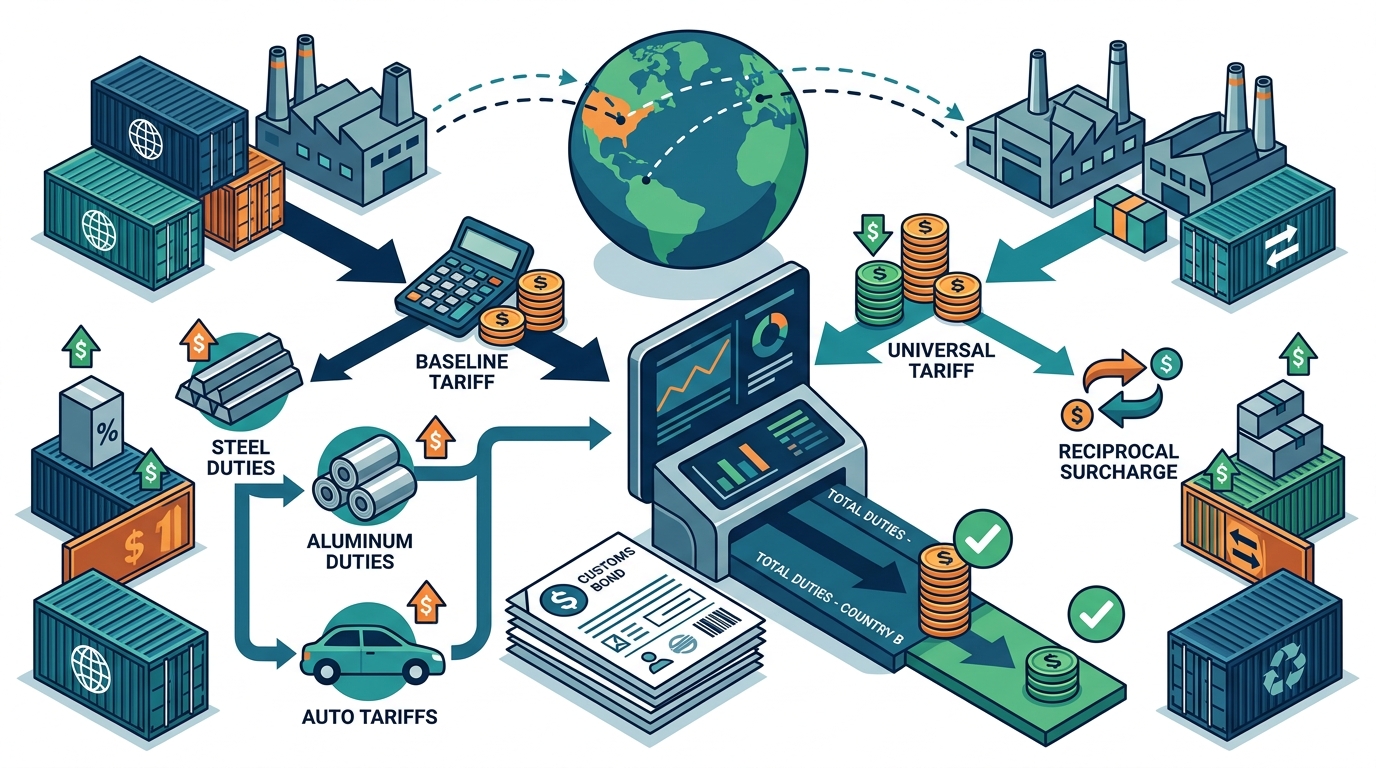
The U.S. tariff landscape in 2026 is dramatically different from even two years ago. Baseline universal tariffs of 10% now apply to most imports, with reciprocal surcharges ranging from 10% to over 40% depending on the country of origin. Sector-specific duties of 25% or more hit steel, aluminum, and automobiles on top of that. Making a sourcing decision without modeling these costs first is a direct threat to your margins.
A tariff calculator enables teams to compare duty rates for identical products across multiple countries of origin. This side-by-side comparison is invaluable when evaluating whether a lower purchase price from a high-tariff country actually beats a slightly higher quote from a country with favorable trade agreements. Importal's country comparison tool was built specifically for this use case.
Key Terms You Need to Know
Tariff
A tariff is a tax levied by governments on the value of imported products, including freight and insurance. Tariffs give a price advantage to locally produced goods and raise revenue for the importing government. In the United States, tariff rates are determined by the product's HTS classification and the country of origin.
Landed Cost
Landed cost is the total expense of getting a product from a foreign supplier to your warehouse, including purchase price, freight, insurance, duties, taxes, and handling fees. Evaluating landed cost rather than unit price alone prevents costly surprises after goods arrive.
Harmonized System (HS) Code
The Harmonized System is an internationally standardized numerical method for classifying traded products. HS codes are standard up to six digits, which is the most detailed level that can be compared internationally according to the World Trade Organization. Each country then extends these codes to eight or ten digits for its own tariff schedule.
Step-by-Step: How to Compare Duties Across Countries
1. Classify Your Product Accurately
Start by determining the correct six-digit HS code for your product. Misclassification is one of the most common and costly errors in international trade. Use Importal's product library to look up or validate your classification with AI-powered HTS tools. Minor variations in classification can create significant differences in duty rates, so precision matters.
2. Identify Candidate Sourcing Countries
List every country where your product or its components can be manufactured. Include current suppliers and potential alternatives. Consider whether free trade agreements like USMCA could reduce or eliminate duties from specific origins. The U.S. has FTAs with more than 20 countries, making FTA-eligible sourcing a competitive market entry strategy.
3. Look Up Duty Rates by Country of Origin
For each candidate country, look up the applicable MFN (Most Favored Nation) tariff rate, any preferential FTA rate, and any additional tariffs such as Section 301, Section 232, or reciprocal surcharges. The U.S. International Trade Administration offers a free Customs Info Database covering duty rates for over 170 countries. Importal's Duty Calculator Pro automates this lookup and layers in all active U.S. tariff programs.
4. Calculate Full Landed Cost for Each Scenario
Multiply the duty rate by the customs value of the goods, then add freight, insurance, the merchandise processing fee, and any applicable taxes. Compare the total landed cost across all candidate countries, not just the duty percentage. A product from a country with a 5% duty rate but high freight costs may end up more expensive than one from a nearby country with a 10% rate and lower shipping fees.
Sample Tariff Comparison Table
The table below illustrates how effective duty rates can vary for the same product (stainless steel kitchen sinks, HTS 7324.10) depending on the country of origin under the 2026 U.S. tariff regime.
| Country of Origin | MFN Duty Rate | Section 232 Duty | Reciprocal Surcharge | Estimated Effective Rate |
|---|---|---|---|---|
| China | 3.4% | 25% | 30% | ~58.4% |
| Vietnam | 3.4% | 0% | 10% | ~13.4% |
| Mexico (USMCA-qualifying) | 0% | 0% | 0% | ~0% |
| India | 3.4% | 0% | 26% | ~29.4% |
| South Korea (KORUS FTA) | 0% | 0% | 10% | ~10% |
Note: Rates are illustrative and vary by exact HTS classification and active executive orders. Always verify with current tariff schedules or a licensed customs broker.
Tools and Data Sources for Tariff Research
Several authoritative resources can help you compare tariffs across countries:
- WTO Tariff Data Platform -- The platform aggregates official information about applied tariffs notified by WTO members, covering bound and applied rates across all member countries.
- U.S. ITA Customs Info Database -- A free tool from the International Trade Administration that searches MFN and FTA duty rates for over 170 countries.
- Importal Country Comparison -- Importal's country comparison tool lets you model duties across multiple origins for any product in your catalog, with real-time updates as tariff programs change.
- USITC Harmonized Tariff Schedule -- The official U.S. tariff schedule published by the International Trade Commission, available online and updated with each Federal Register notice.
Automated platforms that track regulatory changes in real time are especially valuable in the current environment, where tariff programs have shifted multiple times within a single year.
Hidden Costs Beyond the Tariff Rate
Duties are only part of the equation. When comparing sourcing countries, also account for:
- Antidumping and countervailing duties (AD/CVD): These additional duties can add 50% to 400% to the cost of goods from specific countries and producers. Learn more in Importal's guide to understanding antidumping duties.
- Merchandise Processing Fee (MPF): A 0.3464% fee on the value of most U.S. imports, capped at $614.35 per entry. Importal's Compliance 101 guide on MPF breaks this down further.
- Harbor Maintenance Fee (HMF): 0.125% of the value of goods arriving by sea.
- Country-of-origin rules: Transshipment through an intermediate country can trigger higher tariffs if authorities suspect trade circumvention.
- Customs bonds: Required for all U.S. imports, with costs scaling based on your annual duty liability. See Importal's guide to customs bonds.
Key Takeaways
- Always classify your product with the correct HS code before comparing tariff rates across countries.
- Compare total landed cost, not just duty percentages, because freight, fees, and taxes vary significantly by origin.
- Leverage free trade agreements like USMCA and KORUS to access preferential or zero-duty rates on qualifying goods.
- Layer in Section 232, Section 301, and reciprocal tariff surcharges, which can multiply the effective rate dramatically.
- Check for antidumping and countervailing duties that may apply to your product from specific countries.
- Use automated tools that track tariff changes in real time so your sourcing analysis stays current.
- Consult a licensed customs broker to validate your comparison before committing to a new sourcing strategy.
Frequently Asked Questions
What is the easiest way to compare tariffs across countries?
Use a tariff comparison tool that lets you enter your HS code and see duty rates across multiple countries of origin simultaneously. Importal's country comparison tool and the WTO Tariff Data Platform are both effective starting points.
Do free trade agreements eliminate all duties?
Not always. FTAs like USMCA can reduce or eliminate duties on qualifying goods, but the product must meet specific rules of origin. If your product does not meet the origin criteria, the standard MFN rate applies instead.
How often do U.S. tariff rates change?
In the current environment, tariff programs have changed multiple times within a single year. Section 232 rates changed three times in recent years, and Chapter 99 codes have shifted on a near-weekly basis during peak volatility periods.
What is landed cost and why does it matter for sourcing?
Landed cost is the total cost of getting a product to your door, including purchase price, freight, insurance, duties, taxes, and fees. A supplier with a lower unit price may actually be more expensive once duties and logistics are factored in.
Can I reduce tariffs by shipping through a third country?
Generally no. Country-of-origin rules are based on where the product is manufactured or substantially transformed, not where it is shipped from. Transshipment through an intermediate country can trigger higher tariffs and penalties if customs authorities suspect circumvention.
What are antidumping duties and how do they affect sourcing?
Antidumping duties are additional tariffs imposed when a foreign manufacturer sells goods in the U.S. at below fair market value. These duties can range from single digits to several hundred percent and apply on top of standard tariff rates, making certain country-product combinations extremely expensive.
How does Importal help with tariff comparison?
Importal provides AI-powered compliance tools including a duty calculator, country comparison features, and HTS classification support. The platform tracks every regulatory change in real time and surfaces updates directly to licensed customs brokers during entry filing, ensuring your duty estimates reflect the latest tariff environment.
Do I need a customs broker to compare tariffs?
You can do initial research on your own using public databases and tools. However, a licensed customs broker can validate your HTS classification, identify applicable special tariff programs, and catch issues like AD/CVD exposure that are easy to miss in self-service research.
Start Comparing Tariffs Today
Stop guessing about duty costs and start making sourcing decisions backed by real data. Request a demo of Importal's platform to see how AI-powered tariff comparison, HTS classification, and compliance automation can help you find the most cost-effective sourcing strategy for your business.