

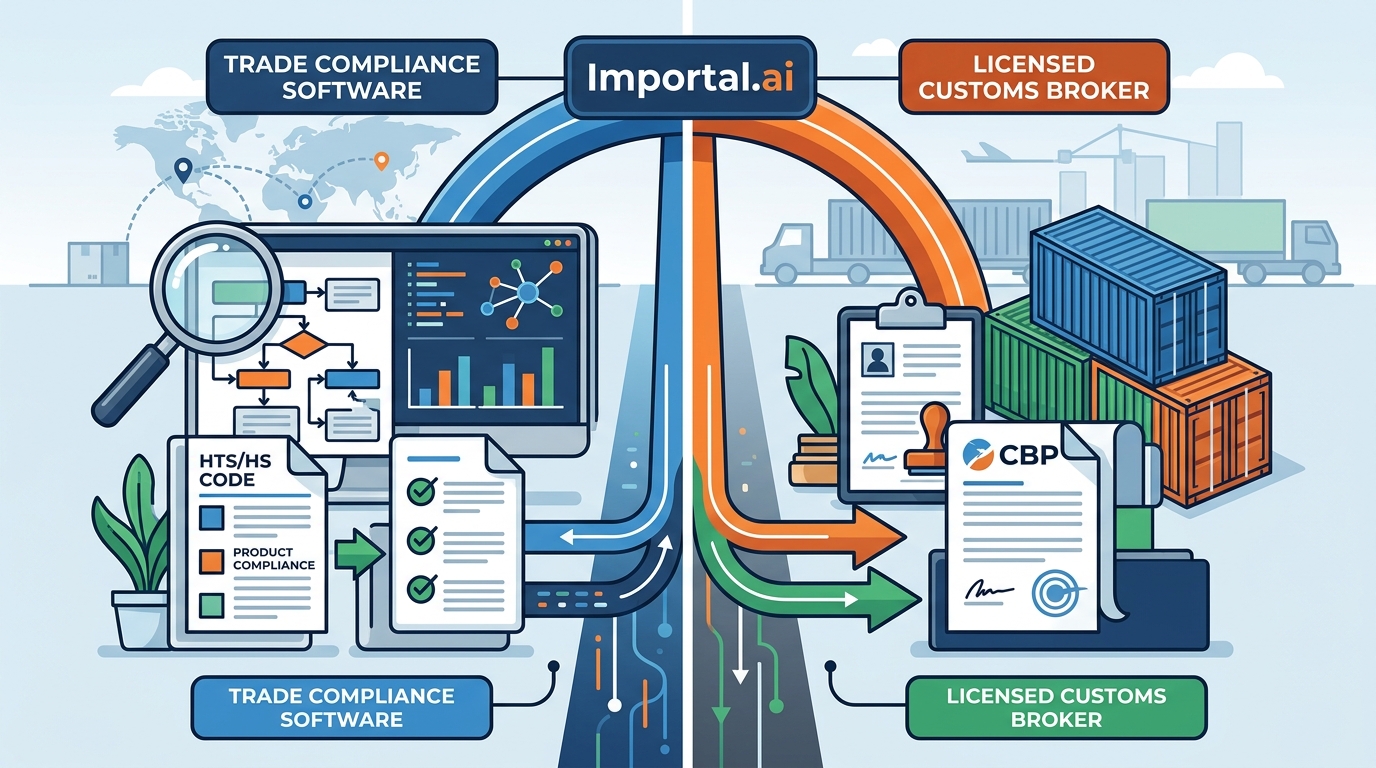
Importers have traditionally had to choose between two separate worlds: trade compliance software that helps classify products and monitor tariffs, and a licensed customs broker who actually files entries with CBP. Most platforms offer one or the other. A compliance tool might give you HTS code suggestions, but you still need a broker to file. A brokerage might clear your shipments, but tracking regulatory changes falls on you. The question many importers are now asking is whether a single platform can do both. The answer is yes, and the model is already live.
What Is AI Compliance Software?
AI compliance software is technology that uses artificial intelligence to automate trade compliance tasks such as HTS classification, duty calculation, tariff monitoring, and regulatory change tracking. These platforms reduce the manual research burden on compliance teams and help catch errors before entries are filed.
Several platforms now offer AI-driven compliance tools. For example, Magaya Customs Compliance includes AI assistants that help brokers research regulatory questions. Others like GingerControl focus on classification research and policy monitoring as standalone tools. The common thread is that AI handles data-intensive work while humans make the final compliance decisions.
Core Capabilities
AI compliance platforms typically cover HTS/HS code classification suggestions, duty and fee calculations, real-time tariff change alerts, and document extraction from shipping paperwork. More advanced systems also flag antidumping duties, partner government agency requirements, and Section 301/232 exposure.
The Role of a Licensed Customs Broker
A licensed customs broker is an individual or entity licensed by U.S. Customs and Border Protection to conduct customs business on behalf of importers. Under 19 U.S.C. § 1641, providing HTS classifications for specific goods intended for importation and filing entries constitutes customs business that requires a license.
Brokers are responsible for filing entry summaries, paying duties on behalf of importers, ensuring compliance with CBP regulations, and maintaining customs bonds. They operate under strict supervision and control obligations defined in 19 CFR Part 111.
The Gap Between Software and Brokerage
Most trade compliance technology companies sell software tools but do not hold a customs broker license. That means they cannot file entries, pay duties, or take legal responsibility for what gets submitted to CBP. Importers using these tools still need to hire a separate broker.
The Handoff Problem
When compliance software and brokerage are separate, data has to move between systems. Classification decisions made in one tool must be communicated to the broker filing entries in another. This creates opportunities for errors, especially during periods of rapid tariff changes like the Section 232 and IEEPA shifts of 2025 and 2026.
Broker Visibility Gap
Traditional brokers often track regulatory changes manually through CSMS messages, Federal Register notices, and executive orders. Without AI-powered monitoring built into their filing workflow, updates can be missed. When a tariff rate changes between the time a product is classified and the time the entry is filed, the importer absorbs the cost of that error.
How a Combined AI + Broker Model Works
Importal is the first AI-powered licensed U.S. customs brokerage. Rather than selling software separately from brokerage services, Importal combines both into a single platform. The compliance tools and the licensed brokers who file your entries operate within the same system.
When tariffs change, the platform catches them and applies updates to entries automatically. Licensed brokers have the right compliance data at their fingertips when they file. When Section 232 rates shift, when Chapter 99 codes change, or when new exclusions take effect, the system flags it before the entry gets filed, not after CBP liquidates it incorrectly.
What This Looks Like in Practice
Importal's platform handles customs clearance, ISF filings, entry processing, customs bonds, duty calculations, and real-time regulatory monitoring in one place. Importers interact with both the technology and the licensed broker team through the same interface. There is no handoff between a software vendor and a separate brokerage.
Platform Model Comparison
| Feature | Standalone AI Software | Traditional Broker | Importal (AI + Licensed Broker) |
|---|---|---|---|
| AI-powered HTS classification | Yes | No | Yes |
| Licensed customs broker filing | No | Yes | Yes |
| Real-time tariff monitoring | Some | Manual | Yes, built into filing workflow |
| Duty calculation engine | Yes | Limited | Yes |
| Customs bonds | No | Yes | Yes |
| ISF filing | No | Yes | Yes |
| Single system for compliance + filing | No | No | Yes |
| Regulatory change auto-applied to entries | No | No | Yes |
Why This Matters in 2026
The regulatory environment is moving faster than any team can manually track. Section 232 tariffs changed multiple times. IEEPA tariffs were struck down by the Supreme Court and replaced within hours. Section 301 investigations expanded to sixteen economies. The FY2027 federal budget proposal includes a 45% funding increase for USTR and an additional $136 million for CBP to modernize ACE.
For importers, this means classification errors, valuation discrepancies, and origin misstatements will receive more scrutiny, not less. A combined AI and brokerage platform eliminates the gap where errors occur between compliance research and entry filing. Explore Importal's Knowledge Hub for real-time trade policy updates covering these developments.
Key Takeaways
- Most trade compliance platforms offer AI tools or brokerage services, but not both in one system.
- A licensed customs broker is legally required to file entries and conduct customs business under 19 U.S.C. § 1641.
- Importal is the first AI-powered licensed U.S. customs brokerage, combining compliance software and broker filing in a single platform.
- Real-time tariff monitoring built into the filing workflow prevents errors caused by manual tracking of regulatory changes.
- The 2026 trade environment, with rapid Section 232, IEEPA, and Section 301 shifts, makes integrated platforms essential.
- Federal enforcement budgets are increasing, meaning entry accuracy is under greater scrutiny than ever.
- Eliminating the handoff between software and broker reduces compliance risk and speeds up customs clearance.
Frequently Asked Questions
What is a licensed customs broker?
A licensed customs broker is a professional authorized by U.S. Customs and Border Protection to file customs entries and conduct customs business on behalf of importers. Licensing is governed by 19 U.S.C. § 1641.
Can AI software replace a customs broker?
No. Under U.S. law, providing HTS classifications for specific goods intended for importation and filing entries with CBP requires a customs broker license. AI software assists with research and compliance tasks, but a licensed broker must make final filing decisions.
Does Importal have licensed customs brokers on staff?
Yes. Importal operates as a licensed U.S. customs brokerage with licensed brokers who file entries, process bonds, and handle compliance directly through the AI-powered platform.
What compliance tasks does Importal's AI handle?
Importal's platform automates HTS classification, duty and fee calculations, regulatory change tracking, tariff monitoring, and document processing. Learn more on the platform overview page.
How does real-time tariff monitoring work?
Importal's system tracks changes to tariff schedules, Chapter 99 codes, exclusions, and trade policy actions as they happen. Updates are automatically flagged and applied during entry filing so brokers always work with current rates.
Is Importal only for large importers?
No. Importal serves businesses of all sizes, from first-time importers to established brands. The platform offers import services scaled to fit different shipping volumes and compliance needs.
What makes Importal different from standalone compliance tools?
Standalone tools provide classification research or tariff data but cannot file entries. Importal combines AI compliance tools with a licensed brokerage, so everything from product classification to entry filing happens in one system with no data handoffs.
How do I get started with Importal?
You can request a demo or start importing through the Importal onboarding page. The team will walk you through compliance tools, brokerage services, and platform integrations.
Ready to Simplify Your Imports?
Stop juggling separate compliance tools and brokerage relationships. Importal brings AI-powered trade compliance and licensed customs brokerage together in one platform. Talk to a licensed broker today and see how the platform works for your supply chain.