

Knowing exactly what you owe in duties and tariffs before your goods ship is no longer optional. With Section 232 tariffs now applying to full customs value, Section 122 replacing struck-down IEEPA rates, and Section 301 surcharges stacking on top of base duties, a single miscalculation can destroy your margins or hold your shipment at the port. An import duty calculator is a tool that estimates the total customs duties, taxes, and fees you will owe when bringing goods into a country. This guide breaks down the best duty calculation tools available today and explains what separates a rough estimate from a compliance-grade answer.
Why You Must Calculate Duties Before Shipping
Landed cost is the total price of a product once it arrives at the buyer's door, including the product price, shipping, insurance, customs duties, import taxes, brokerage fees, and handling charges. If you skip this step, you are flying blind on profitability.
In the current tariff environment, duties can stack quickly. A product imported from China may face a base MFN duty, a Section 301 surcharge of 7.5% to 100% depending on the product category, plus a 10% Section 122 global tariff. For steel or aluminum goods, Section 232 adds another 25% to 50%. Getting these numbers wrong does not just hurt margins; it can trigger antidumping duty exposure and compliance penalties from CBP.
What Every Duty Calculator Needs in 2026
Not all calculators are created equal. The 2026 tariff landscape demands tools that handle multiple layers of duties simultaneously. A tariff calculator is a tool that applies the correct duty rate based on an HTS code, country of origin, and declared value, then adds applicable taxes and fees.
Full Tariff Stack Coverage
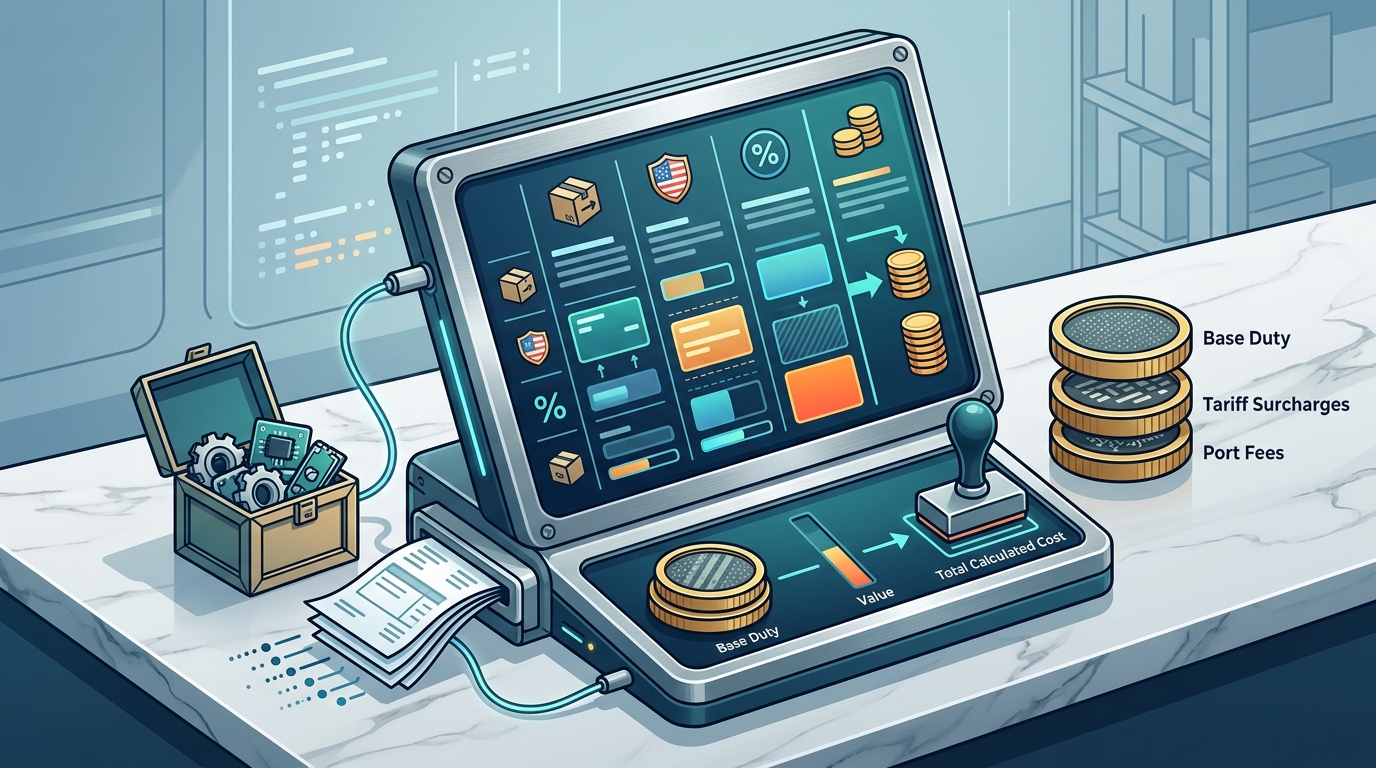
The best tools calculate base MFN duty, Section 301 (China), Section 232 (steel, aluminum, copper, autos, pharmaceuticals), Section 122 (global 10%), Merchandise Processing Fee (MPF), and Harbor Maintenance Fee (HMF) in a single output. Free calculators that show only a base rate miss the layers that often double or triple total costs.
Real-Time Rate Updates
Tariff rates changed weekly throughout 2025 and 2026. Section 232 alone changed multiple times, and Chapter 99 codes shifted regularly. Any tool running on data older than a few weeks can produce dangerously wrong results. Look for tools that cite Federal Register notices and presidential proclamations as their data sources.
HTS Code Classification
Your HTS code is the single biggest variable in any duty calculation. A one-digit difference can mean 0% duty versus 25%. The Harmonized Tariff Schedule, published by the U.S. International Trade Commission (USITC), contains over 17,000 distinct product classifications. Tools with built-in AI classification help, but only a licensed customs broker can provide a binding determination.
Top Import Duty Calculators Compared
The table below compares key features across popular duty calculators based on publicly available information as of May 2026.
| Tool | Tariff Stack Coverage | AI HTS Classification | Country Comparison | Licensed Broker Access | Cost |
|---|---|---|---|---|---|
| Importal Duty Calculator Pro | Full (MFN + 301 + 232 + 122 + MPF/HMF) | Yes | Yes | Yes (in-house licensed brokers) | Platform subscription |
| Flexport Tariff Simulator | Full | No (requires HTS input) | Yes | No (separate service) | Free |
| Gateway Tariff Calculator | Full (30,000+ HTS codes) | No | Yes | No | Free |
| SimplyDuty | Partial | Yes | Yes | No | Freemium |
| CBP CROSS Database | Reference only | No | No | N/A | Free |
Free tools cover the basics well, but most miss at least one layer of the current tariff stack, and none handle the full complexity of derivative steel or aluminum content calculations or date-sensitive rate changes without manual work.
Importal Duty Calculator Pro: AI Plus Licensed Brokers
What makes Importal's Duty Calculator Pro different is that it sits inside a full trade compliance platform backed by licensed U.S. customs brokers. The platform tracks every regulatory change in real time, and when tariffs change, it applies updates to entries automatically.
Where standalone calculators give you an estimate and stop, Importal connects the calculation directly to customs clearance, import bonds, and entry filing. This means the same duty data that powers your pre-shipment estimate is the data your broker uses when filing with CBP. That eliminates the gap between what you expected to pay and what actually gets assessed.
Country Comparison for Sourcing Decisions
Importal's country comparison tool lets importers see how duties change when sourcing the same product from different origins. In a world where a single sourcing shift from China to Vietnam or Mexico can cut total duties by 30% or more, this feature directly supports tariff reduction strategies.
How to Use a Duty Calculator Effectively
Step 1: Identify Your HTS Code
Start with the most specific product description you have. Use the Importal Product Library or the USITC database to find the correct 10-digit HTS code. Searching generic terms like "electronics" will not return useful results because the Harmonized Tariff Schedule uses specific classification language.
Step 2: Enter Origin Country and Declared Value
U.S. customs duties are calculated on the CIF value, which is the cost of goods plus international shipping and insurance. Many first-time importers make the mistake of using only the product invoice price, which understates the dutiable value.
Step 3: Review the Full Breakdown
Verify that the output includes every applicable layer: base duty, any Section 301 or 232 surcharges, MPF (0.3464% of customs value, minimum $31.67, maximum $614.35 per entry), and HMF (0.125% for ocean shipments). If your tool shows only one duty rate, it is almost certainly incomplete.
Common Mistakes That Lead to Wrong Duty Estimates
Using outdated rates. Tariff policy changed faster in 2025 and 2026 than at any point in modern U.S. trade history. A calculator running on rates from even two months ago can produce significantly wrong results in a fast-changing tariff environment.
Wrong HTS code. A single digit difference in your HTS code can mean 0% duty versus 25% duty. If you are uncertain about classification, consult a licensed customs broker before shipping.
Ignoring trade agreements. USMCA-compliant goods from Canada and Mexico can enter duty-free, but only if they meet rules of origin requirements. Free Trade Agreements (FTAs) are an exception to the Most Favored Nation (MFN) principle, which generally requires equal tariff treatment across WTO members.
Forgetting AD/CVD duties. Antidumping and countervailing duties are product- and manufacturer-specific. No free calculator covers these automatically. Review antidumping duty requirements separately.
Key Takeaways
- Always calculate total landed cost, not just base duty rates, before committing to a shipment.
- The 2026 tariff environment requires tools that handle tariff stacking across Section 232, Section 301, Section 122, MPF, and HMF simultaneously.
- Your HTS code is the single most important input; a wrong code changes everything downstream.
- Free calculators are useful for quick estimates but miss edge cases like AD/CVD, derivative metal content, and date-sensitive rate changes.
- Importal Duty Calculator Pro combines AI-powered calculations with licensed customs broker review for compliance-grade accuracy.
- Country comparison tools help identify sourcing alternatives that can reduce duties by 30% or more.
- No calculator replaces a licensed customs broker for binding duty determinations and complex entries.
Frequently Asked Questions
What is an import duty calculator?
An import duty calculator is a tool that estimates the total customs duties, taxes, and fees owed when importing goods into a country. You typically enter the product's HTS code, country of origin, and declared value to receive a cost breakdown.
How accurate are free duty calculators?
Free duty calculators provide close estimates based on published tariff schedules, but final charges may vary depending on CBP classification rulings, valuation adjustments, and AD/CVD orders. They are best used for planning, not as a compliance guarantee.
What fees does CBP charge beyond customs duty?
CBP collects a Merchandise Processing Fee (MPF) of 0.3464% of customs value on formal entries and a Harbor Maintenance Fee (HMF) of 0.125% on ocean shipments. Section 301, Section 232, and Section 122 surcharges may also apply depending on the product and origin.
Can a duty calculator tell me my correct HTS code?
Some AI-powered calculators suggest HTS codes based on product descriptions, but these are recommendations, not binding rulings. The USITC publishes and maintains the official HTS, while CBP is responsible for its interpretation and enforcement. For high-value or complex shipments, work with a licensed customs broker.
How often do U.S. tariff rates change?
In 2025 and 2026, rates changed frequently due to new Section 232 proclamations, Section 301 reviews, the Supreme Court striking down IEEPA tariffs in February 2026, and the introduction of Section 122 surcharges. Any tool you use should update at least weekly from official Federal Register sources.
What is the de minimis threshold for U.S. imports?
The U.S. de minimis value is $800 per person per day. Shipments under this value are generally exempt from formal duties and do not require formal customs entry, though they must still comply with other agency requirements.
How does Importal's duty calculator differ from free tools?
Importal's Duty Calculator Pro is integrated into a full trade compliance platform with licensed U.S. customs brokers. The same duty data that powers pre-shipment estimates is used during actual entry filing, eliminating discrepancies between estimated and assessed duties. Free tools provide estimates only and cannot file entries or issue binding classifications.
Should I use a customs broker or just a calculator?
Use a calculator for initial cost estimates and sourcing comparisons. Use a licensed customs broker for official entry filing, binding HTS classification, and complex scenarios involving AD/CVD, trade agreements, or regulatory compliance. Importal combines both in one platform.
Get Accurate Duty Calculations Backed by Licensed Brokers
Stop guessing what your shipment will cost at the border. Talk to an Importal licensed customs broker today and get compliance-grade duty calculations before your next shipment sails.