

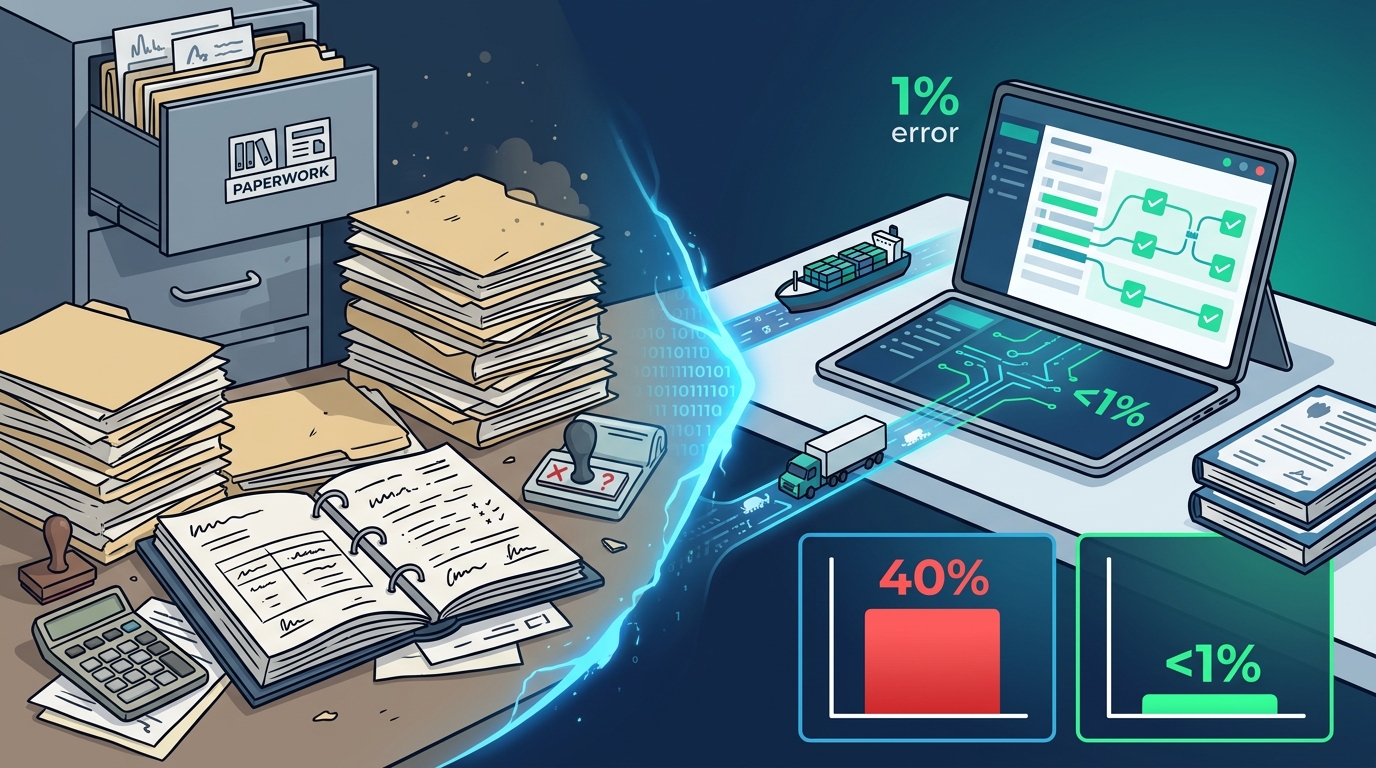
For decades, customs entry in the United States has relied on manual data entry, paper-based documentation, and spreadsheets updated by hand. The result is predictable: classification errors, delayed shipments, compliance penalties, and brokers struggling to keep pace with regulatory changes that now shift weekly. According to industry analysis, manual data entry error rates in customs documentation can reach as high as 40%, while automated systems bring that figure below 1%. The good news is that AI-powered customs platforms now exist to replace these outdated workflows entirely. This guide explains what is broken, what the alternatives look like, and how to make the switch.
Why Manual Customs Entry Processes Fail
A customs entry is a formal declaration submitted to U.S. Customs and Border Protection (CBP) that provides details about imported goods, their classification, value, and country of origin. When this process is done manually, every data point is typed by hand, cross-referenced against paper records, and validated through spreadsheets.
The problems compound quickly. Tariff codes change frequently. In 2025 and 2026 alone, Section 232 rates changed multiple times, Chapter 99 codes shifted on a near-weekly basis, and IEEPA tariffs were struck down by the Supreme Court. Brokers who track these changes manually are, as Importal's knowledge hub reports, "updating spreadsheets and hoping they caught everything."
An audit of entries filed by traditional brokers found an average error rate of 20%, meaning one in five entries contained mistakes. Those errors do not just cost money. They invite CBP scrutiny, delay refunds, and can trigger full audits.
What Customs Entry Automation Actually Means
Customs entry automation is the use of software, AI, and machine learning to digitize and streamline the filing of import declarations, compliance checks, and duty calculations. It replaces repetitive manual tasks with intelligent workflows that validate data in real time.
Core Capabilities
Modern platforms handle data capture and extraction using OCR and AI, automatically pulling information from commercial invoices, bills of lading, and packing lists. They cross-check every entry against current regulatory requirements before submission, catching discrepancies that a human reviewer might miss.
Where It Fits in the Workflow
Automation does not eliminate the customs broker. It empowers them. Platforms like Importal's compliance platform surface real-time regulatory data directly to licensed brokers during entry filing, so classification and tariff changes are applied before the entry reaches CBP, not after.
Manual vs. Automated Customs Entry: A Direct Comparison
| Factor | Manual Process | AI-Automated Process |
|---|---|---|
| Data Entry Error Rate | Up to 40% | Below 1% |
| Tariff Code Updates | Tracked via CSMS messages and spreadsheets | Applied automatically in real time |
| Compliance Validation | Broker reviews manually before filing | System cross-checks against live regulations |
| Processing Speed | Hours per entry | Minutes per entry |
| Audit Risk | Higher due to misclassification | Reduced through pre-filing validation |
| Scalability | Requires more staff for more volume | Handles volume increases without proportional headcount |
The gap between these two approaches is growing. As trade regulations become more volatile, manual methods fall further behind. Importal's compliance tools are designed to close that gap for importers and brokers alike.
AI-Powered HTS Classification and Duty Calculation
HTS classification is the process of assigning a Harmonized Tariff Schedule code to an imported product, which determines the duty rate applied at the border. Getting it wrong means overpaying, underpaying, or triggering a CBP investigation.
How AI Improves Accuracy
AI classification tools analyze product descriptions, materials, and intended use against the full HTS schedule. They identify the most accurate code and flag potential issues before filing. Importal's product library lets importers store validated classifications so they are reused consistently across future shipments.
Duty Calculation at Scale
With tariff rates now layered across base duties, Section 301 tariffs, Section 232 tariffs, and antidumping duties, manual calculation is unreliable. Automated duty calculators pull current rates in real time, including special tariff programs, to produce accurate landed cost estimates before goods ship.
Real-Time Compliance Tracking in a Volatile Trade Environment
The U.S. trade regulatory environment is moving faster than any team can manually track. The FY2027 federal budget proposal requested a 45% funding increase for the Office of the U.S. Trade Representative and an additional $136 million for CBP to modernize its ACE system. That means more enforcement staff, more scrutiny, and higher stakes for entry accuracy.
Why Spreadsheets Cannot Keep Up
Section 301 investigations recently expanded to sixteen economies. Section 232 tariffs now apply to the full customs value of steel, aluminum, and copper imports. USMCA is under review. Each change hits entries, classifications, and duty rates in real time. Compliance professionals who spend their days manually pulling CSMS messages and cross-referencing Federal Register notices cannot focus on the strategic decisions that require judgment.
The Automated Alternative
Importal's platform tracks every regulatory change and flags it before the entry gets filed. When Section 232 rates change or Chapter 99 codes shift, the system surfaces those updates directly to licensed brokers during entry filing. Learn more about how this works on the import services page.
How to Choose the Right Customs Automation Platform
Not every automation tool is built for customs compliance. When evaluating platforms, look for these capabilities:
- Licensed brokerage integration: The platform should work with or include licensed U.S. customs brokers, not replace them.
- Real-time regulatory tracking: Updates to tariff codes, trade agreements, and executive orders should flow into the system automatically.
- HTS classification support: AI-assisted classification with the ability to store and reuse validated codes.
- Duty and fee calculation: Accurate, current calculations that account for layered tariff programs.
- API and integration support: The platform should connect with your existing logistics and ERP systems. Importal offers API integration for this purpose.
Importal is the first AI-powered licensed U.S. customs brokerage. It combines real-time compliance tracking, AI classification, and licensed broker expertise into a single platform built for the complexity of modern trade.
Key Takeaways
- Manual customs entry processes produce error rates as high as 40%, while automated systems reduce errors to below 1%.
- The U.S. trade regulatory environment is changing faster than any manual process can track, with tariff codes shifting weekly in some cases.
- AI-powered HTS classification reduces misclassification risk and ensures consistent code application across shipments.
- Real-time compliance tracking catches tariff changes before entries are filed, not after CBP flags errors during liquidation.
- CBP is investing heavily in enforcement infrastructure, making entry accuracy more important than ever.
- Automation does not replace customs brokers. It gives them better tools to file accurately and efficiently.
- Platforms like Importal combine AI automation with licensed brokerage expertise, purpose-built for modern importers.
Frequently Asked Questions
What is a customs entry?
A customs entry is a formal filing submitted to U.S. Customs and Border Protection declaring the details of imported goods, including their classification, value, quantity, and country of origin. It is required for most commercial imports into the United States.
Why are manual customs entry processes unreliable?
Manual processes rely on human data entry, which introduces errors at rates up to 40%. Combined with rapidly changing tariff codes and regulations, manual workflows cannot keep pace with modern trade compliance requirements.
Can AI replace customs brokers entirely?
No. AI enhances the work of licensed customs brokers by automating data capture, classification, and compliance checks. However, licensed brokers remain essential for exercising professional judgment, managing complex regulatory scenarios, and maintaining legal accountability for filings.
What is HTS classification?
HTS classification is the process of assigning a Harmonized Tariff Schedule code to an imported product. This code determines the applicable duty rate and any special tariff programs or restrictions that apply to the goods.
How does real-time compliance tracking work?
Real-time compliance tracking uses software to continuously monitor regulatory changes, including new tariff rates, trade agreements, executive orders, and CBP guidance. Updates are automatically applied to entry workflows so brokers always file with current data.
What are the risks of filing customs entries with errors?
Errors can result in overpayment or underpayment of duties, delayed shipments, CBP audits, compliance penalties, and loss of refund eligibility. In fraud cases, penalties can reach up to 80% of the goods' value.
How quickly can a company transition to automated customs entry?
Most modern platforms, including Importal, are designed for rapid onboarding. Importers can typically begin filing through an automated platform within days, not months, especially when the platform includes integrated brokerage services.
Does Importal work with freight forwarders?
Yes. Importal serves importers, customs brokers, and freight forwarders across the United States, providing compliance tools and brokerage services that integrate into existing logistics workflows.
Ready to Replace Your Outdated Customs Workflows?
Stop relying on spreadsheets and manual processes that cannot keep up with today's trade environment. Talk to a licensed broker at Importal and see how AI-powered customs automation can reduce errors, speed up clearance, and keep your entries compliant from day one.