

Choosing where to source products is no longer just about unit price and lead time. In 2026, with overlapping Section 122, Section 232, and Section 301 tariffs reshaping the U.S. import landscape, the duty rate attached to a country of origin can swing your landed cost by tens of thousands of dollars per container. Comparing duties and tariffs across countries before you commit to a supplier is one of the highest-leverage moves an importer can make. This guide walks you through the process step by step, from understanding the tariff stack to using modern tools that automate the comparison for you.
Why Comparing Tariffs Before Sourcing Matters
Tariffs are no longer a static line item. Trade policy volatility has fundamentally changed how companies approach sourcing, pricing, and network design. A product sourced from China may carry a combined duty rate exceeding 60% once Section 301 and Section 122 tariffs are layered on top of the base MFN rate, while the same product from a USMCA-compliant Mexican factory could enter duty-free.
Failing to account for all import costs can lead to unexpected expenses that erode profit margins and make a seemingly affordable product too costly to import. Companies that integrate tariff analysis into their sourcing decisions routinely save 10% to 40% on landed cost simply by shifting origin countries or adjusting product classifications.
The Cost of Getting It Wrong
Errors in classification or undervaluing goods can trigger regulatory fines, delayed shipments, or legal penalties. A misapplied HTS code does not just cost you money at the border. It can flag your entries for a broader CBP audit, especially in the current enforcement environment where the U.S. government is investing heavily in trade compliance infrastructure.
Understanding the U.S. Tariff Stack
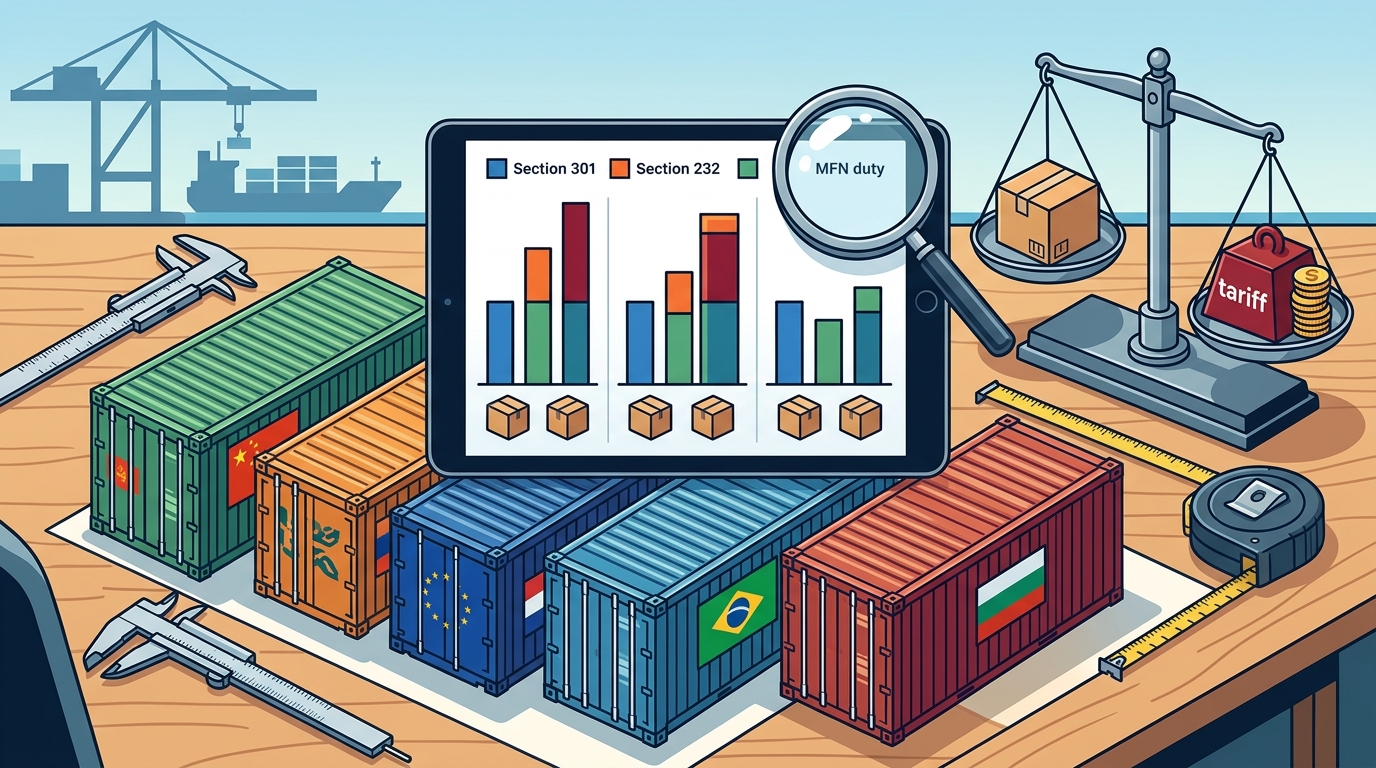
U.S. import duties are built from multiple overlapping tariff layers. Each layer is authorized by a different law and administered independently. The total duty you pay is the sum of all applicable layers. Here is how they stack up in 2026:
| Tariff Layer | Authority | Rate Range | Applies To |
|---|---|---|---|
| MFN Base Duty | Harmonized Tariff Schedule | 0% - 37.5% | All imports (product-specific) |
| Section 122 | Trade Act of 1974 | 10% | All countries equally |
| Section 232 | Trade Expansion Act of 1962 | 25% - 50% | Steel, aluminum, autos, copper |
| Section 301 | Trade Act of 1974 | 7.5% - 100% | Chinese product categories |
| AD/CVD | Tariff Act of 1930 | Varies widely | Product + country specific |
A landed cost comparison is the process of calculating the total cost of importing a product, including base duties, special tariffs, merchandise processing fees, harbor maintenance fees, freight, and insurance. Without accounting for every layer, your comparison will be incomplete.
Start With the Right HTS Code
An HTS code is a standardized numerical classification assigned to every product crossing international borders. In the United States, HTS codes extend to 10 digits, and the specific code determines your base duty rate, eligibility for trade agreements, and exposure to special tariffs. The Harmonized System (HS) is standard up to six digits internationally, which is the most detailed level that can be compared across countries.
Getting this code right is the foundation of any tariff comparison. Minor variations in classification can create significant differences in duty rates. Importal's product library helps importers lock in accurate HTS classifications using AI-powered search, so every downstream duty calculation starts from the correct baseline.
Authoritative Data Sources for Tariff Comparison
Several free and paid resources let you look up duty rates by country and product:
- Importal Country Comparison Tool - Side-by-side duty comparison across sourcing countries, built specifically for U.S. importers.
- U.S. International Trade Administration - Offers links to the Customs Info Database (Descartes), which covers MFN and FTA duty rates for over 170 countries.
- WTO Tariff Data Platform - Aggregates official applied tariffs and bound duties notified by WTO members, useful for benchmarking.
- USITC DataWeb - Provides realized tariff rates and import statistics by country and HTS code.
The challenge with public databases is that they often lag behind real-time tariff changes. Rates shifted multiple times in 2025 and 2026, and brokers manually tracking these updates are inevitably missing things. A platform like Importal's compliance tools tracks every regulatory change in real time, so your duty estimates always reflect current rates.
Step-by-Step: Running a Country-by-Country Duty Comparison
Step 1: Identify Your Product's HTS Code
Use Importal's AI-powered product library or the USITC HTS search to find the correct 10-digit code. Confirm it with a licensed customs broker if the product is complex or falls near a classification boundary.
Step 2: List Your Candidate Sourcing Countries
Select the three to five countries where viable suppliers exist. Include at least one FTA partner (e.g., a USMCA country) and one non-FTA origin to establish a cost baseline.
Step 3: Calculate the Full Duty Stack for Each Origin
For each country, add up the MFN base rate, any applicable Section 122, 232, or 301 tariffs, antidumping or countervailing duties, and the merchandise processing fee (0.3464% of value). Importal's Duty Calculator Pro automates this entire calculation, including all special tariff layers, so you see the true total in seconds.
Going Beyond Duties: Calculate True Landed Cost
Duty rates alone do not tell the whole story. True landed cost incorporates duties, transportation, insurance, handling, and other fees. A supplier in Vietnam may offer a lower unit price than one in Mexico, but once you add a 10% Section 122 tariff, ocean freight, longer transit time, and carrying cost for additional safety stock, Mexico may win on total cost.
Procurement teams can use tools like the Importal country comparison tool to model these scenarios before committing. Consider also whether the product qualifies for duty reduction strategies like first sale valuation or foreign trade zone benefits, which can further shift the math in favor of one origin over another.
For a deeper look at tariff reduction strategies, read Importal's strategic guide to reducing tariffs.
Key Takeaways
- Always compare the full duty stack, not just the MFN base rate, when evaluating sourcing countries.
- HTS classification accuracy is the foundation of every tariff comparison. Get it wrong and every number downstream is off.
- Use real-time tools rather than static spreadsheets. Tariff rates in 2026 change faster than any team can manually track.
- USMCA-compliant goods from Canada and Mexico can enter duty-free for most product categories, making them strong sourcing alternatives.
- Section 301 tariffs on Chinese goods range from 7.5% to 100%, creating a massive cost gap versus other Asian origins.
- Landed cost includes far more than duties. Factor in freight, insurance, lead time, and carrying costs for a true comparison.
- AI-powered platforms like Importal automate duty calculations and flag regulatory changes before entries are filed.
Frequently Asked Questions
What is the difference between a duty and a tariff?
A duty is a tax collected by customs on imported goods, calculated based on product classification, country of origin, and declared value. A tariff is a specific type of duty applied to imports from certain countries or product categories, often motivated by trade policy goals. In practice, the terms are frequently used interchangeably.
How do I find the duty rate for a specific product from a specific country?
Start by identifying your product's HTS code. Then use a tariff lookup tool like the Importal Duty Calculator Pro, the USITC DataWeb, or the Customs Info Database to see the applicable rate for that HTS code from your target country of origin.
Do free trade agreements eliminate all tariffs?
Not necessarily. FTAs like USMCA eliminate tariffs on most qualifying goods, but special tariffs such as Section 232 steel and aluminum duties still apply on top of FTA preferences. You must also meet rules of origin requirements to claim preferential rates.
What are Section 301 tariffs?
Section 301 tariffs are additional duties imposed under the Trade Act of 1974 on thousands of Chinese product categories, with rates ranging from 7.5% to 100%. They were originally imposed in response to unfair trade practices and remain in force in 2026.
How often do U.S. tariff rates change?
Frequently. In 2025 and 2026, Section 232 changed multiple times, IEEPA tariffs were struck down by the Supreme Court, and Section 122 replaced them within hours. Staying current requires either constant manual monitoring or an automated compliance platform.
What is landed cost?
Landed cost is the total expense of getting a product from the supplier's door to your warehouse. It includes the purchase price, import duties, freight, insurance, customs brokerage fees, merchandise processing fees, and harbor maintenance fees.
Can I reduce my tariff exposure without changing suppliers?
Yes. Strategies like first sale valuation, foreign trade zones, tariff engineering, and duty drawback can lower your effective duty rate. Importal's tariff reduction guide covers these approaches in detail.
Why should I use an AI-powered tool instead of a spreadsheet?
Spreadsheets cannot keep pace with the rate of regulatory change. An AI-powered platform tracks tariff updates in real time, applies them automatically, and reduces the classification errors that lead to overpayment or CBP audits.
Get Started With Importal
Stop guessing at duty rates and start making sourcing decisions backed by real-time tariff intelligence. Importal's platform combines AI-powered HTS classification, automated duty calculations, and side-by-side country comparisons into a single compliance workflow. Request a demo today and see how much you could save on your next shipment.