

AI Compliance Software With a Licensed Customs Broker: Does It Exist?
Importers have long been forced to choose between two imperfect options: software tools that automate parts of trade compliance but lack regulatory authority, or traditional customs brokers who hold the license but rely on manual spreadsheets and outdated workflows. The question many supply chain leaders are now asking is whether a single platform can deliver both AI-driven compliance automation and the accountability of a licensed U.S. customs broker. The short answer is yes. A new category of customs brokerage is emerging that combines real-time AI compliance tools with licensed broker oversight, and it is already changing how companies clear goods through U.S. Customs and Border Protection (CBP).
Why Importers Need Both AI and a Licensed Broker
A licensed customs broker is a professional authorized by CBP to conduct customs business on behalf of importers in the United States. Under 19 CFR Part 111, brokers must exercise responsible supervision over every entry filed, maintain accurate records, and ensure compliance with all applicable regulations.
AI compliance software is technology that uses machine learning, natural language processing, and predictive analytics to automate customs workflows such as HTS classification, document extraction, and tariff calculation. These tools accelerate processing but cannot, on their own, accept legal responsibility for the accuracy of a customs entry.
The gap is clear: software alone cannot sign off on an entry, and a broker working manually cannot keep pace with today's regulatory velocity. Importers need both capabilities working together in one system.
The Compliance Gap in Software-Only Solutions
Many AI trade compliance tools on the market focus on a single function like HS code lookup or document scanning. They hand off results to a separate brokerage team, creating a disconnect between the data and the filing.
Classification Without Accountability
An AI tool can suggest an HTS code, but unless a licensed broker validates and files that classification, the importer bears all the risk. CBP has not yet defined specific rules for AI use in customs filings, but existing regulations require that brokers remain directly involved in every decision.
No Real-Time Tariff Updates
Standalone software products often lag behind the pace of regulatory change. When Section 232 rates shift, Chapter 99 codes update, or new exclusions take effect, importers relying on disconnected tools may file entries with outdated duty rates. The consequences range from overpayment to CBP penalties.
How an AI-Powered Licensed Brokerage Works
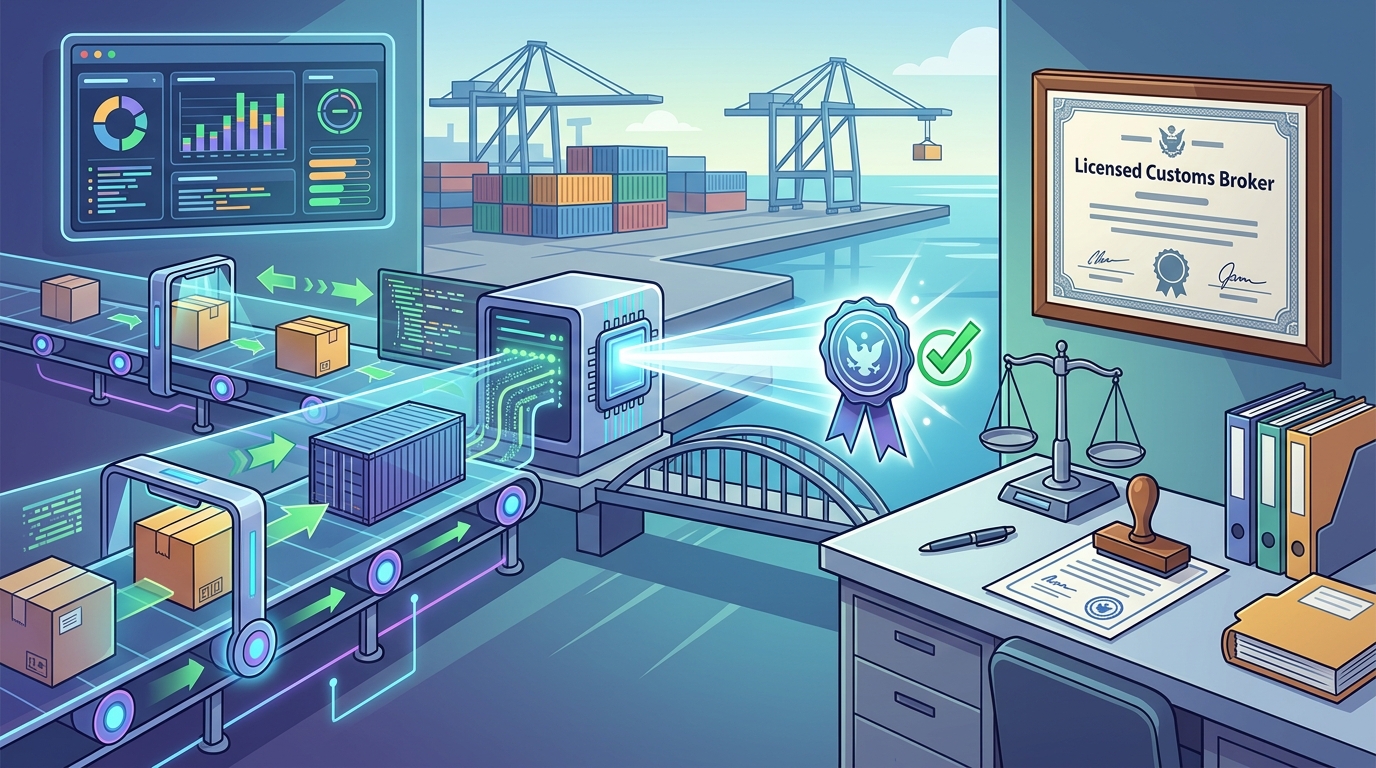
Importal is the first AI-powered licensed U.S. customs brokerage. The platform combines artificial intelligence with licensed broker oversight in a single integrated workflow. AI validates every data point across the entry and all partner government agency (PGA) requirements. Then a licensed Importal broker reviews and files the entry with CBP.
Nothing is auto-filed blindly. Every entry is submitted with speed, accuracy, and accountability. Once filed, the platform monitors clearance in real time and tracks any tariff, compliance, or exam risk so importers have full visibility into duties paid and release status.
What the AI Handles
The AI layer automates data extraction from commercial documents, validates HTS classifications against current tariff schedules, calculates duties including Section 301 and Section 232 rates, and flags compliance risks before the entry is filed. The compliance tools run checks across restricted-party lists, PGA requirements, and active trade remedy orders.
What Licensed Brokers Handle
Licensed brokers at Importal review every flagged entry, resolve CBP holds and examinations, advise on tariff reduction strategies, and take legal responsibility for the accuracy and completeness of each filing. This division of labor means importers get both speed and accountability.
Traditional Broker vs. AI Compliance Platform vs. Combined Model
| Capability | Traditional Broker | AI Software Only | AI + Licensed Broker (Importal) |
|---|---|---|---|
| Licensed to file entries with CBP | Yes | No | Yes |
| AI-powered HTS classification | No | Yes | Yes |
| Real-time tariff and regulatory tracking | Manual | Varies | Automated |
| Entry review by licensed broker | Yes | No | Yes |
| Automated duty calculation (301, 232, AD/CVD) | Manual | Partial | Yes |
| Customs bond issuance | Yes | No | Yes |
| Real-time clearance monitoring | Limited | Limited | Yes |
| Compliance audit trail | Paper-based | Digital | Digital |
Real-Time Regulatory Tracking in a Volatile Tariff Environment
The U.S. trade environment in 2025 and 2026 has been the most volatile in decades. Section 232 tariffs have changed multiple times. IEEPA tariffs were struck down by the Supreme Court. Section 301 investigations have expanded to cover 60 countries. New Section 122 tariffs appeared within hours of the IEEPA ruling. Traditional brokers are manually tracking CSMS messages, Federal Register notices, and executive orders, then updating spreadsheets and hoping they caught everything.
Importal's platform tracks every regulatory change in real time and surfaces it directly to licensed brokers during entry filing. When rates change, the system catches them and applies updates to entries automatically before they are filed, not after CBP liquidates them incorrectly. This is the core advantage of combining AI with licensed brokerage: the technology does the monitoring work so that compliance professionals can focus on judgment calls.
For importers navigating antidumping duties, customs bonds, or shifting tariff rules, this combination provides a level of accuracy and speed that neither software nor traditional brokerage can deliver alone.
Key Takeaways
- A licensed customs broker is legally required to exercise responsible supervision over every customs entry filed in the United States.
- AI compliance software accelerates classification, document processing, and duty calculations but cannot accept legal responsibility for filings.
- Importal is the first platform to combine AI-powered trade compliance automation with a licensed U.S. customs brokerage under one roof.
- Real-time regulatory tracking is critical in a tariff environment where Section 232, Section 301, and Chapter 99 codes change frequently.
- Traditional brokers relying on manual processes face a 20% average error rate on entries, according to audit data cited by Importal.
- Software-only solutions create a compliance gap because no licensed broker reviews or takes responsibility for the entry before it is filed.
- The combined model ensures every entry is AI-validated and broker-reviewed before submission to CBP.
Frequently Asked Questions
What is an AI-powered customs brokerage?
An AI-powered customs brokerage is a licensed customs broker that uses artificial intelligence to automate compliance workflows such as HTS classification, duty calculation, and document validation while maintaining licensed broker oversight on every filing.
Can AI replace a licensed customs broker?
No. U.S. regulations under 19 CFR Part 111 require that a licensed broker exercise responsible supervision over customs entries. AI assists with speed and accuracy, but a human broker must review, validate, and take accountability for every entry filed with CBP.
How does Importal combine AI with customs brokerage?
Importal's platform uses AI to validate data across the entry and all PGA requirements. A licensed Importal broker then reviews the entry and files it with CBP. The system also tracks regulatory changes in real time and applies tariff updates automatically before filing.
What types of duties does the AI calculate?
The platform calculates standard ad valorem duties, Section 301 tariffs, Section 232 tariffs on steel, aluminum, and copper, antidumping and countervailing duties, and merchandise processing fees. You can explore the Duty Calculator Pro for detailed estimates.
Does Importal offer customs bonds?
Yes. Importal provides both single entry bonds and continuous customs bonds. You can learn more on the import bonds page or read the guide to customs bonds.
How does real-time regulatory tracking work?
Importal's system monitors CSMS messages, Federal Register notices, executive orders, and tariff schedule updates continuously. When a change is detected, the platform flags affected entries and applies the correct rates before the broker files, reducing the risk of incorrect duty payments.
Is my data secure on the Importal platform?
Yes. Importal follows industry-standard data security practices. For details on data handling and privacy, visit the privacy policy.
Who is Importal best suited for?
Importal serves importers, freight forwarders, and logistics providers across the United States. Whether you are a first-time importer or a high-volume shipper, the platform scales to your needs. Visit the freight forwarders page or import services page for more detail.
Talk to a Licensed Broker Today
If you are looking for a platform that combines AI compliance automation with the accountability of a licensed U.S. customs broker, Importal is built for exactly that. Stop choosing between technology and expertise. Request a demo and see how AI-powered customs brokerage works in practice.