

AI Compliance Software With a Licensed Customs Broker: Why You Need Both in One Platform
Importers today face a dilemma. AI tools promise speed and automation for customs filings, but U.S. Customs and Border Protection (CBP) still requires a licensed customs broker to exercise responsible supervision over every entry. Most companies are forced to choose between a fast software platform and a licensed brokerage that files compliantly. But what if you did not have to choose? A new category of trade technology combines AI-powered compliance software with licensed customs brokerage under one roof, giving importers speed, accuracy, and legal accountability in a single platform.
What Is AI Compliance Software for Customs?
AI compliance software is a technology platform that uses machine learning, natural language processing, and automation to handle customs processes such as HTS code classification, document extraction, duty calculation, and restricted-party screening. These tools can reduce manual data entry by over 80% and process documents in minutes rather than hours.
The value proposition is clear: faster entry preparation, fewer classification errors, and scalable throughput. Platforms like these can suggest accurate HTS codes based on product descriptions, flag missing documents before filing, and calculate total landed costs including duties and fees.
However, AI software alone cannot legally file a customs entry in the United States. That responsibility falls on a licensed customs broker or the importer of record.
Why a Licensed Customs Broker Still Matters
A licensed customs broker is a professional authorized by CBP to conduct customs business on behalf of importers. Under 19 CFR Part 111, brokers must exercise responsible supervision and control over every customs transaction they handle.
This means a licensed broker must ensure the accuracy, legality, and completeness of documentation for every entry filed. AI can assist with data validation, but the legal accountability rests with the broker. No AI tool, no matter how sophisticated, can replace this regulatory requirement.
When Human Judgment Is Non-Negotiable
Complex scenarios demand broker expertise. These include customs holds requiring direct communication with CBP officers, partner government agency reviews where permits must be submitted quickly, and tariff engineering strategies where product design changes affect classification outcomes. AI flags issues; brokers resolve them.
The Error Rate Problem
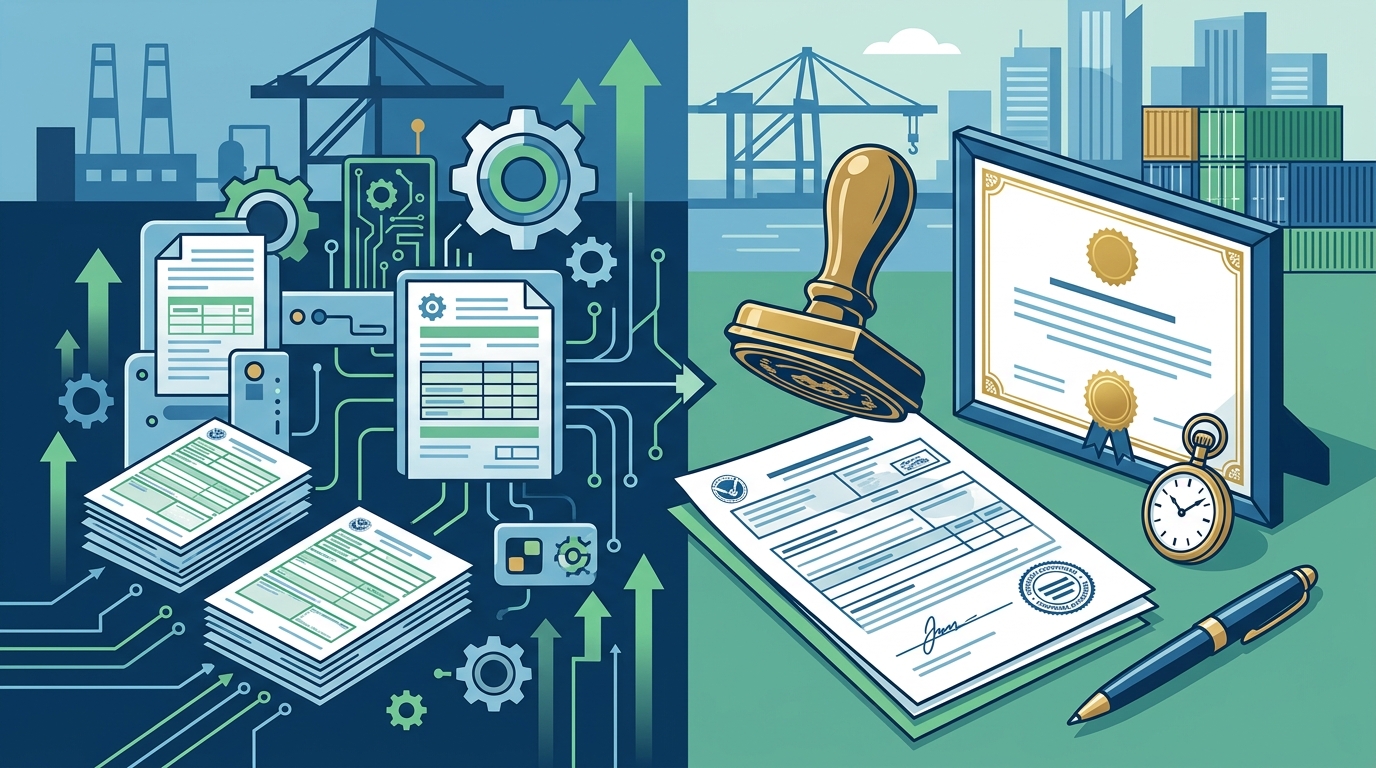
An audit of entries filed by traditional brokers found an average error rate of 20%. One in five entries contained misclassifications, valuation errors, or incorrect country-of-origin declarations. In today's enforcement climate, those errors carry real financial and legal risk. The solution is not to remove brokers but to give them better tools.
The Gap Between Software-Only and Broker-Only Models
Most importers are stuck between two imperfect options. Software-only platforms offer speed and automation but provide no licensed broker to file entries or resolve CBP issues. Traditional brokerages offer licensed expertise but rely on manual processes that cannot keep pace with today's regulatory changes.
Software-only tools stop at the data. They classify, extract, and validate, but they cannot file entries, handle customs holds, or advise on duty mitigation strategies like first sale programs. Traditional brokers, meanwhile, are manually tracking CSMS messages, Federal Register notices, and executive orders, then updating spreadsheets and hoping they caught everything.
The gap leaves importers exposed. They get speed without accountability, or accountability without speed.
How Importal Combines AI Software With Licensed Brokers
Importal is the first AI-powered licensed U.S. customs brokerage. The platform uses AI to validate every data point across the entry and all partner government agency (PGA) requirements. Then a licensed Importal broker reviews and files with CBP. Nothing is auto-filed blindly. Every entry is submitted with speed, accuracy, and accountability.
This model solves the core tension between automation and compliance. The AI handles data extraction, HTS classification validation, duty calculations, and regulatory screening. The licensed broker handles judgment calls, exception management, and legal responsibility.
What Happens After Filing
Once an entry is filed, Importal monitors clearance in real time and tracks any tariff, compliance, or exam risk. Importers get visibility into duties paid, release status, and downstream impact so there are no surprises after cargo arrives. This level of post-filing transparency is rare in traditional brokerage.
Customs Bonds and Documentation
Importal also provides complete customs bond services, including continuous and single-entry bonds, ISF filings, and entry clearance. The platform consolidates every compliance workflow into one place rather than requiring importers to coordinate across multiple vendors.
Real-Time Regulatory Tracking in a Volatile Tariff Environment
The U.S. tariff landscape has shifted dramatically in 2025 and 2026. Section 232 tariffs changed multiple times. IEEPA tariffs were struck down by the Supreme Court. Section 301 investigations expanded to cover 60 countries. Section 122 replaced IEEPA tariffs within hours. Keeping up manually is no longer feasible.
Importal's platform tracks every regulatory change in real time. When tariffs change, the system catches them and applies updates to entries automatically. When Section 232 rates change, when Chapter 99 codes shift, when new exclusions take effect, the system flags it before the entry gets filed. This is the difference between proactive compliance and reactive cleanup.
Importers navigating today's tariff volatility can explore Importal's Knowledge Hub for the latest regulatory updates and strategic guidance on topics like how to reduce tariffs.
Traditional Broker vs. AI-Only Tool vs. AI + Broker Platform
| Capability | Traditional Broker | AI-Only Software | AI + Licensed Broker (Importal) |
|---|---|---|---|
| Licensed to file entries with CBP | Yes | No | Yes |
| AI-powered HTS classification | No | Yes | Yes |
| Real-time tariff tracking | Manual | Varies | Automated |
| Post-filing compliance monitoring | Limited | No | Yes |
| Customs bond services | Yes | No | Yes |
| Duty mitigation advisory | Yes (manual) | No | Yes (AI-assisted) |
| Handles CBP holds and exams | Yes | No | Yes |
| Scalable document processing | No | Yes | Yes |
Key Takeaways
- AI compliance software is a technology platform that automates customs data extraction, classification, and validation, but it cannot legally file entries in the U.S.
- A licensed customs broker is a CBP-authorized professional who bears legal responsibility for the accuracy and completeness of every customs entry.
- Most platforms offer either AI automation or licensed brokerage, but not both together.
- Importal is the first AI-powered licensed U.S. customs brokerage, combining automated compliance tools with licensed broker oversight in one platform.
- Real-time regulatory tracking is essential in the current tariff environment, where Section 232, Section 301, and other trade rules change frequently.
- An integrated AI-plus-broker model reduces entry error rates, speeds up clearance, and ensures legal accountability.
- Importers should evaluate whether their current customs partner provides both the technology and the licensing needed for compliant, efficient trade.
Frequently Asked Questions
Can AI replace a licensed customs broker?
No. Under U.S. law (19 CFR Part 111), a licensed customs broker must exercise responsible supervision over every entry filed with CBP. AI can support the broker with data validation and classification, but it cannot replace the legal accountability that a licensed broker provides.
What is the advantage of using AI and a customs broker together?
Combining AI with a licensed broker gives importers both speed and compliance. AI handles repetitive data tasks like document extraction and HTS classification, while the broker provides legal oversight, resolves exceptions, and files entries with CBP.
Does Importal auto-file entries without human review?
No. Importal uses AI to validate data points and PGA requirements, but a licensed Importal broker reviews every entry before it is submitted to CBP. Nothing is auto-filed blindly.
How does Importal track tariff changes in real time?
Importal's platform monitors regulatory updates including CSMS messages, Federal Register notices, and executive orders. When tariff rates, Chapter 99 codes, or exclusions change, the system flags updates and applies them to entries before filing.
What customs services does Importal offer beyond clearance?
Importal provides customs bonds (continuous and single-entry), ISF filings, duty calculations, HTS classification, compliance tools, and a knowledge hub with regulatory updates. Visit the import services page for a full list.
Is Importal only for large importers?
No. Importal serves businesses of all sizes, from first-time importers to established brands. The platform is designed to make customs compliance accessible, whether you are shipping one container or hundreds.
How do I get started with Importal?
You can request a demo or start importing directly through the Importal website. A licensed broker will guide you through onboarding, bond setup, and your first customs entry.
Ready to Combine AI Speed With Licensed Broker Expertise?
Stop choosing between automation and compliance. Importal is the only platform that gives you AI-powered trade compliance tools and a licensed U.S. customs broker in one place. Talk to a licensed broker today and see how Importal can simplify your imports from day one.