

AI Compliance Software With a Licensed Customs Broker: Why You Need Both
Importers today face a difficult choice: use standalone AI compliance software that lacks regulatory authority, or rely on a traditional customs broker who still tracks tariff changes with spreadsheets. The good news is you no longer have to choose. A new category of trade compliance platform combines artificial intelligence with licensed customs brokerage under one roof. This model pairs real-time AI automation with the human expertise and legal accountability that U.S. Customs and Border Protection (CBP) requires. In this post, we break down why this combination matters, what to look for, and how it changes the way importers manage compliance.
What Is AI Compliance Software?
AI compliance software is technology that uses machine learning, natural language processing, and predictive analytics to automate customs and trade compliance tasks. These tasks include HTS code classification, duty calculations, document extraction, and restricted-party screening.
The value proposition is speed and consistency. AI systems can process thousands of documents per hour and flag discrepancies in real time, something no human team can match at scale. As trade volumes climb and regulatory requirements grow more complex, manual workflows simply cannot keep up.
However, software alone has a critical limitation. It cannot legally file entries with CBP, resolve customs holds, or take responsibility for the accuracy of a filing. That is where a licensed broker comes in.
Why a Licensed Customs Broker Still Matters
A licensed customs broker is a private individual or business entity licensed and regulated by CBP to assist importers in conducting customs business. Under 19 CFR Part 111, brokers must exercise "responsible supervision and control" over every customs transaction they handle. This means a licensed broker must ensure the accuracy, legality, and completeness of documentation for every entry filed.
CBP's modernized broker regulations, finalized in October 2022, reinforced these obligations. Brokers cannot delegate final decision-making to AI. They must directly execute powers of attorney with clients and remain accountable for filings.
What Happens Without a Licensed Broker
Any person who transacts customs business without a valid broker's license faces monetary penalties for each transaction. More importantly, importers who rely on unlicensed tools for filing risk compliance gaps that can trigger CBP audits, delayed shipments, and penalty assessments.
The Gap Between Software-Only and Broker-Only Models
Most AI trade compliance tools on the market today fall into one of two categories. Software-only platforms offer powerful classification and automation features but do not employ licensed brokers. They hand off data to a separate brokerage, creating a disconnect between the compliance intelligence and the filing process.
Broker-only firms, on the other hand, employ licensed professionals but rely on manual processes. Traditional brokers are often manually tracking CSMS messages, Federal Register notices, and executive orders, then updating spreadsheets and hoping they catch every change. In a tariff environment where Section 232, Section 301, and Chapter 99 codes shift regularly, that manual approach produces errors.
The result is a compliance gap. Software catches the data but cannot act on it. Brokers can act but lack the real-time intelligence to act accurately.
How a Combined AI and Brokerage Platform Works
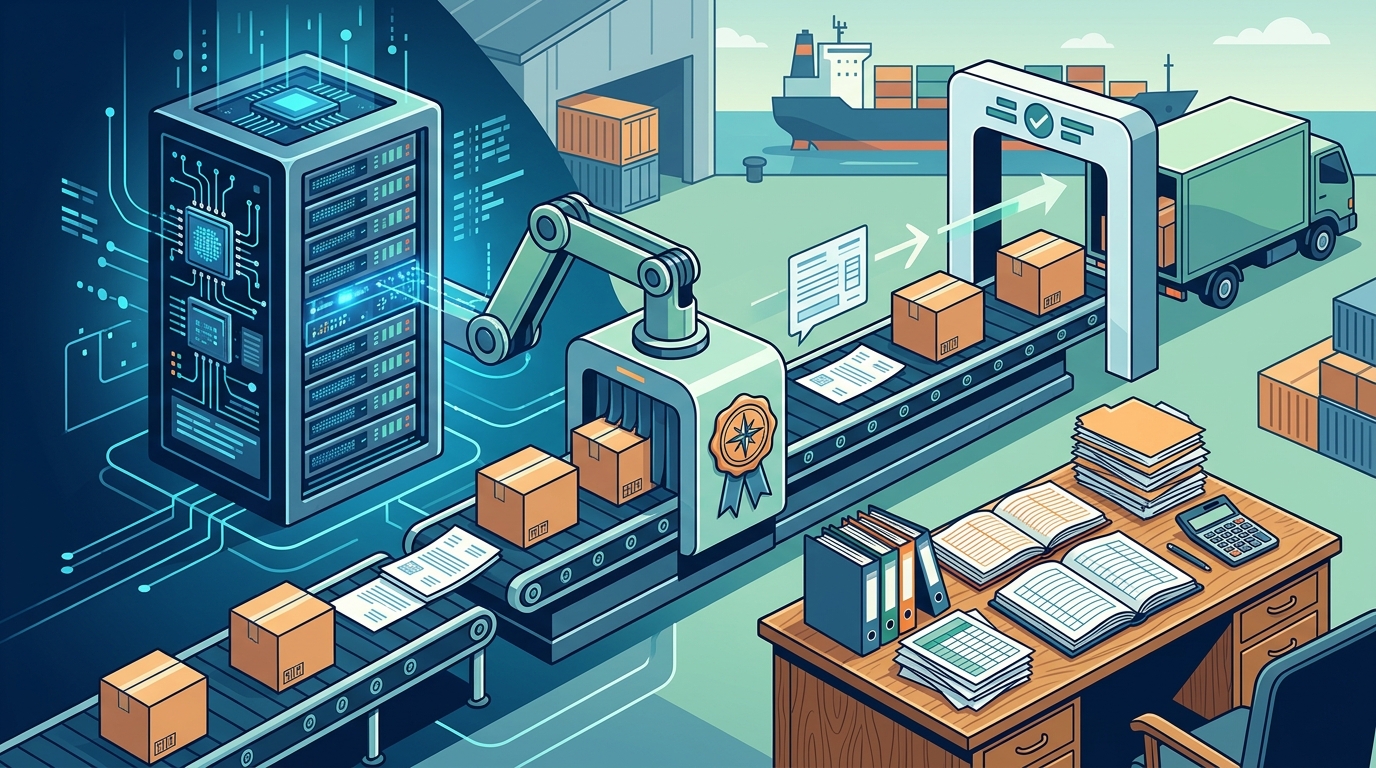
Importal is an example of this combined model. Importal is the first AI-powered licensed U.S. customs brokerage. The platform uses AI to validate every data point across the entry and all partner government agency (PGA) requirements. Then a licensed Importal broker reviews and files with CBP.
AI Handles the Data Layer
The AI layer tracks every regulatory change in real time. When tariffs change, the system catches them and applies updates to entries automatically. When Section 232 rates shift, when Chapter 99 codes update, or when new exclusions take effect, the platform flags it before the entry gets filed.
Licensed Brokers Handle the Filing
Nothing is auto-filed blindly. Every entry is submitted with speed, accuracy, and accountability by a licensed broker who has the right compliance data at their fingertips. This is the key differentiator: AI does the heavy lifting on data validation and regulatory tracking, while the broker provides the legal authority and professional judgment required by CBP.
Importal's platform also supports full import services including ISF filings, entry clearance, customs bonds, and duty calculations.
What to Look for in a Platform
Not all platforms that claim AI compliance capabilities are equal. Here is what importers should evaluate:
- Licensed brokerage: Does the platform employ its own licensed customs brokers who file entries directly with CBP?
- Real-time regulatory tracking: Does the system automatically monitor tariff changes, CSMS messages, and Federal Register notices?
- Human review before filing: Is there a licensed broker reviewing every entry before submission, or is the process fully automated without oversight?
- Integrated compliance tools: Does the platform offer compliance tools like HTS classification, duty estimation, and PGA search in one place?
- Transparency: Can you see duties paid, release status, and downstream impact after filing?
Importers should also evaluate whether the platform provides educational resources. Importal's Knowledge Hub publishes real-time trade updates and compliance guides that help importers stay informed.
Comparison: Software-Only vs. Broker-Only vs. Combined
| Feature | Software-Only | Broker-Only | Combined (AI + Broker) |
|---|---|---|---|
| AI-powered HTS classification | Yes | No | Yes |
| Licensed customs broker on staff | No | Yes | Yes |
| Real-time tariff tracking | Varies | Manual | Automated |
| Entry filing with CBP | No (requires separate broker) | Yes | Yes |
| Pre-filing AI validation | Yes | No | Yes |
| Regulatory change alerts | Varies | Manual monitoring | Real-time, automated |
| Customs bonds and ISF | No | Yes | Yes |
| Duty calculation tools | Varies | Manual | AI-assisted |
Key Takeaways
- AI compliance software is technology that automates trade compliance tasks like classification, screening, and document processing, but it cannot legally file entries with CBP.
- A licensed customs broker is a CBP-regulated professional required to exercise responsible supervision and control over every customs transaction.
- Software-only tools create a disconnect between compliance intelligence and the filing process, increasing the risk of errors.
- Traditional brokers who track regulations manually struggle to keep pace with the current rate of tariff changes across Section 232, Section 301, and IEEPA-related codes.
- A combined platform like Importal's customs clearance service pairs AI data validation with licensed broker review before every filing.
- CBP regulations under 19 CFR Part 111 require responsible supervision by licensed brokers, making human oversight non-negotiable.
- The best approach for modern importers is a platform where AI and licensed brokers work together in a single workflow.
Frequently Asked Questions
Can AI replace a licensed customs broker?
No. Under CBP regulations, a licensed customs broker must exercise responsible supervision and control over every entry filed. AI can assist with data validation and classification, but it cannot replace the legal accountability of a licensed broker.
What is a licensed customs broker?
A licensed customs broker is an individual or business entity licensed by U.S. Customs and Border Protection to assist importers in conducting customs business, including filing entries, classifying goods, and paying duties.
What does AI compliance software do for importers?
AI compliance software automates tasks like HTS code classification, document extraction, duty calculations, and restricted-party screening. It reduces manual data entry and improves accuracy across the compliance workflow.
Is Importal a licensed customs brokerage?
Yes. Importal is the first AI-powered licensed U.S. customs brokerage. The platform combines AI automation with licensed brokers who review and file every entry with CBP.
Why is real-time tariff tracking important?
Tariff rates and trade regulations change frequently. In 2025 and 2026, Section 232, Section 301, and IEEPA tariffs changed multiple times. Real-time tracking ensures your entries reflect current rates before filing, reducing the risk of overpayment or CBP penalties.
What is responsible supervision and control under 19 CFR 111?
Responsible supervision and control is the CBP requirement that a licensed broker oversee all customs transactions performed under their permit. This includes reviewing entries, maintaining compliance with regulations, and ensuring the accuracy of filings.
How does a combined AI and broker platform reduce errors?
The AI layer pre-validates data, flags regulatory changes, and checks classification accuracy before the entry reaches a broker. The broker then applies professional judgment and files with CBP. This two-layer approach catches errors that either AI or humans alone would miss.
Do I still need a customs bond if I use an AI platform?
Yes. A customs bond is a financial guarantee required by CBP for importing goods into the United States. Whether you use AI software, a traditional broker, or a combined platform, you still need either a single entry bond or a continuous bond.
Talk to a Licensed Broker Today
If you are looking for a platform that combines AI compliance software with licensed customs brokerage, schedule a demo with Importal. See how real-time AI validation and licensed broker review work together to simplify your imports and protect your compliance.