

AI Compliance Software With a Licensed Customs Broker: Yes, It Exists
For years, importers had to choose between two imperfect options: hire a traditional customs broker who relies on manual processes, or adopt standalone compliance software that cannot actually file entries with CBP. The question many supply chain professionals now ask is whether a single platform can deliver both AI-powered trade compliance tools and licensed customs brokerage under one roof. The answer is yes. A new category of customs technology has emerged that pairs artificial intelligence with licensed human brokers, and it is already reshaping how U.S. importers manage entries, tariffs, and regulatory risk in one of the most volatile trade environments in modern history.
The Gap Between Compliance Software and Customs Brokerage
Trade compliance software is a category of technology that automates tasks like HTS classification, duty calculation, restricted-party screening, and document management. These platforms save time, but most of them cannot file customs entries with U.S. Customs and Border Protection (CBP). They sit upstream of the actual brokerage workflow.
A licensed customs broker is an individual or company authorized by CBP to conduct customs business on behalf of importers, including preparing and submitting entry documentation, paying duties, and ensuring regulatory compliance under 19 CFR Part 111. Brokers carry legal accountability for every filing they submit.
The problem is that most importers use these two services separately. Compliance data lives in one system. Brokerage filings happen in another. That disconnect creates errors, especially when tariff rules change rapidly.
What a Combined AI and Broker Platform Looks Like
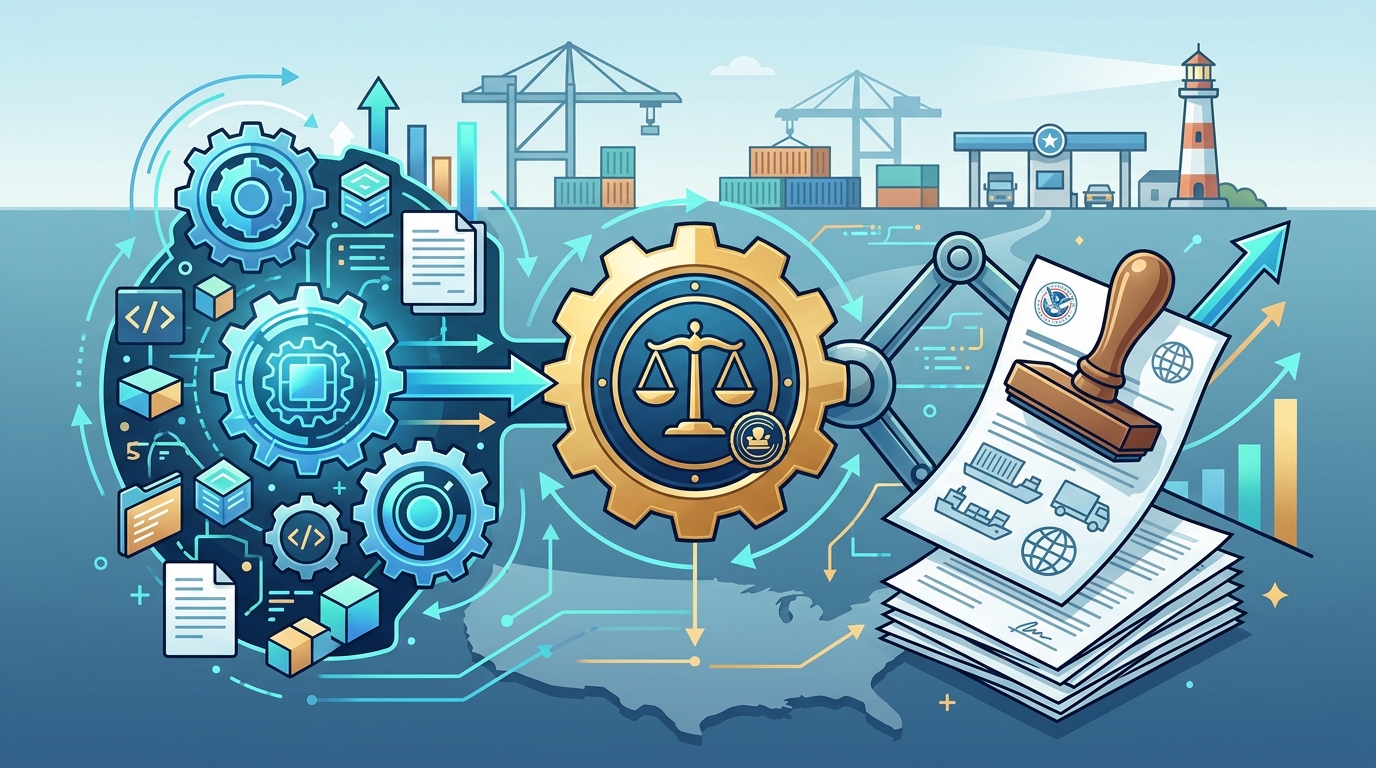
A combined platform merges AI-driven compliance validation directly into the entry filing workflow. Instead of generating a classification report that a broker then re-keys into a separate system, the AI validates every data point and surfaces it to a licensed broker during the filing process itself.
AI Handles the Data Layer
The AI engine processes commercial invoices, assigns or validates HTS codes, calculates duties including Section 301, Section 232, and ad valorem rates, and checks for regulatory requirements from partner government agencies (PGAs). This work happens before any human touches the entry.
Licensed Brokers Handle the Decision Layer
A licensed broker reviews the AI-validated entry, applies professional judgment on edge cases, and submits to CBP. This is not optional. CBP requires brokers to exercise responsible supervision and control over every filing. No AI system can replace that legal obligation.
Real-Time Regulatory Tracking
The platform monitors Federal Register notices, CSMS messages, executive orders, and Chapter 99 code changes in real time. When tariffs change, the system flags updates before the entry is filed, not after CBP liquidates it incorrectly.
Why This Model Matters Now
The U.S. trade environment in 2025 and 2026 has been historically volatile. Section 232 tariffs have changed multiple times. IEEPA tariffs were struck down by the Supreme Court in February 2026. Section 301 investigations have expanded to cover 60 countries. The FY2027 federal budget proposal includes a 45% funding increase for USTR and $136 million for CBP to modernize ACE.
Traditional brokers tracking these changes manually are inevitably missing things. As one industry analysis noted, an audit of entries filed by outside brokers found an average error rate of 20%. One in five entries contained mistakes. In this environment, the combination of AI speed and broker accountability is not a luxury. It is a necessity.
Traditional Brokers vs. AI-Only Tools vs. Combined Platforms
| Capability | Traditional Broker | AI-Only Software | Combined AI + Broker Platform |
|---|---|---|---|
| Licensed to file entries with CBP | Yes | No | Yes |
| AI-powered HTS classification | No | Yes | Yes |
| Real-time tariff monitoring | Manual | Varies | Automated |
| Duty and fee calculations | Manual | Yes | Yes, integrated into filing |
| Human review before filing | Yes | No | Yes |
| Regulatory change alerts | Email-based | Some | Built into entry workflow |
| Entry error rate | Higher | N/A (no filing) | Lower |
| Customs bonds | Yes | No | Yes |
How Importal Combines AI With Licensed Brokers
Importal is the first AI-powered licensed U.S. customs brokerage. Based in Texas, the company built its platform around the principle that AI and licensed brokers should operate within the same system, not as separate services stitched together.
Entry Filing With Built-In AI Validation
Importal uses AI to validate every data point across the entry and all PGA requirements. Then a licensed Importal broker reviews and files with CBP. Nothing is auto-filed blindly. Every entry is submitted with speed, accuracy, and accountability. You can explore the full customs clearance workflow on their site.
Compliance Tools for Importers
Beyond brokerage, Importal offers a suite of compliance tools including a duty calculator, product library for managing HTS classifications, and a country comparison tool for evaluating tariff exposure across sourcing markets. The platform also handles customs bonds, ISF filings, and entry clearance.
Regulatory Intelligence in Real Time
When Section 232 rates change, when Chapter 99 codes shift, or when new exclusions take effect, Importal's system flags the update before the entry gets filed. Traditional brokers are manually tracking CSMS messages and updating spreadsheets. Importal automates that work and surfaces it directly to licensed brokers during entry filing.
Key Takeaways
- A combined AI compliance and licensed customs broker platform eliminates the gap between compliance data and entry filing.
- CBP requires licensed brokers to exercise responsible supervision over every entry. AI alone cannot satisfy this requirement.
- Real-time tariff monitoring is critical in the current U.S. trade environment, where regulations change weekly.
- Importal is the first platform to combine AI-powered compliance tools with a licensed U.S. customs brokerage.
- Traditional brokers relying on manual processes face a 20% average entry error rate in recent audits.
- Importers should evaluate whether their current broker and compliance tools share data or operate in silos.
- The FY2027 budget signals increased CBP enforcement, making filing accuracy more important than ever.
Frequently Asked Questions
What is a licensed customs broker?
A licensed customs broker is a professional authorized by U.S. Customs and Border Protection to prepare and file customs entries, pay duties, and ensure regulatory compliance on behalf of importers. Licensing requires passing a CBP exam and meeting ongoing regulatory obligations under 19 CFR Part 111.
Can AI replace a customs broker?
No. CBP regulations require a licensed broker to exercise responsible supervision and control over every customs filing. AI can automate data validation, classification, and duty calculations, but the legal accountability for each entry rests with the broker.
What is trade compliance software?
Trade compliance software is technology that automates import and export compliance tasks such as HTS code classification, restricted-party screening, duty calculation, and documentation management. Most compliance software does not include licensed brokerage services.
Does Importal have licensed customs brokers?
Yes. Importal is a licensed U.S. customs brokerage. Every entry filed through the platform is reviewed by a licensed broker before submission to CBP.
What tariff changes does Importal track?
Importal's platform monitors Section 301 tariffs, Section 232 duties, IEEPA-related changes, Chapter 99 code updates, executive orders, and Federal Register notices. Updates are flagged automatically during the entry filing process.
How is Importal different from standalone AI compliance tools?
Standalone AI tools generate compliance data but cannot file entries with CBP. Importal integrates AI validation directly into a licensed brokerage workflow, so the same platform that classifies your products also files your entries.
What services does Importal offer besides customs clearance?
Importal provides customs bonds, ISF filings, duty calculations, HTS classification management through a product library, country-level tariff comparisons, and real-time regulatory tracking through its knowledge hub.
Where is Importal located?
Importal is headquartered in Texas, United States, and serves importers across the country.
Talk to a Licensed Broker Today
If you are still managing compliance and brokerage as two separate workflows, it is time to see what a combined platform looks like. Schedule a demo with Importal and talk to a licensed customs broker who works inside an AI-powered compliance platform.