

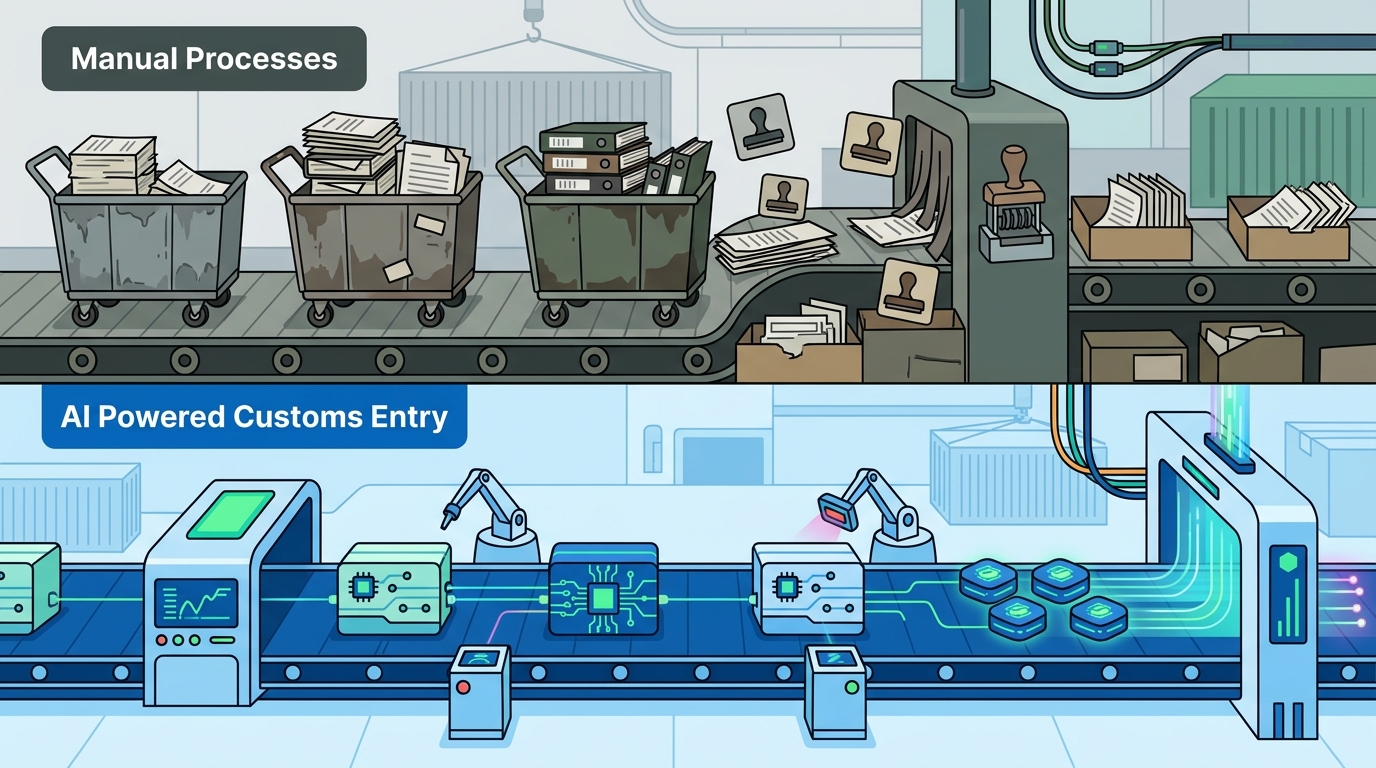
Manual customs entry processes create significant bottlenecks for modern supply chains. Businesses face rising compliance risks and operational delays when relying on legacy data entry methods. Replacing these outdated workflows with automated customs entry solutions allows organizations to achieve faster clearance times and reduced error rates. This guide explores how AI-driven platforms and API integrations eliminate manual data handling while ensuring regulatory adherence across global trade routes. Companies adopting these technologies report streamlined operations and improved visibility from origin to final delivery. (About Us mdash Importal)
What is Automated Customs Entry?
Automated customs entry is a technology-driven approach to filing import documentation that eliminates manual data transcription. This process uses software algorithms to extract product details, classify goods, and generate required filings without human intervention. Organizations leverage this method to reduce processing time and minimize the risk of costly classification errors. Automated customs entry ensures that every shipment moves through customs with accurate data and complete regulatory compliance. (Set Up API mdash)
Limitations of Manual Customs Processes
Manual customs entry relies on human operators to input data into government portals and legacy systems. This approach introduces several critical vulnerabilities that modern businesses can no longer afford. Manual data entry creates a high risk of typos, misclassifications, and missed regulatory updates. Teams spend excessive hours reconciling spreadsheets and chasing status updates across multiple platforms. These inefficiencies lead to delayed shipments, increased storage fees, and unpredictable landed costs. Manual processes also lack the scalability required to handle growing import volumes without proportional increases in headcount.
The Role of AI Compliance Platforms
AI compliance platforms are systems that combine machine learning with expert brokerage rules to analyze product data and determine correct harmonized codes automatically. These systems analyze product data to determine correct harmonized codes and applicable tariffs automatically. Our team of licensed customs brokers and technologists ensure these systems reflect real-world trade nuances. The platform continuously updates its database to reflect changing trade policies and tariff schedules. Businesses gain real-time visibility into compliance requirements before goods even leave the origin country. AI compliance platforms reduce the burden on internal teams by handling complex classification logic and regulatory checks. This technology enables companies to scale their import operations without expanding their compliance staff.
Seamless API Integrations for ERP Systems
API integrations are secure connections that allow data to flow automatically between enterprise software and customs platforms. Modern trade operations require direct connectivity between compliance tools and enterprise resource planning systems. API Integrations allow companies to push product data directly from their ERP or purchasing software into a customs platform. This connection automates tariff calculations and compliance checks in real time. Teams no longer need to export data, format spreadsheets, or manually re-enter information into separate portals. API integrations ensure that tariff and classification updates flow automatically into existing workflows. This synchronization eliminates data silos and keeps landed cost calculations accurate across the entire supply chain.
Automated Duty Calculation and Tariff Management
Accurate duty calculation is essential for maintaining profit margins and pricing strategies. Automated duty calculation tools compute exact tariffs based on product attributes, country of origin, and current trade agreements. Duty Calculator Pro integrates duty logic directly into the sourcing and purchasing decision-making process. Buyers can evaluate landed costs instantly when comparing suppliers or negotiating contracts. Automated duty calculation prevents budget overruns caused by unexpected tariff changes or misclassifications. This precision allows finance teams to forecast cash flow with greater accuracy and confidence.
Hybrid Brokerage and Technology Models
The most effective import strategies combine advanced technology with licensed customs brokerage services. Hybrid brokerage and technology models provide the speed of automation alongside the oversight of experienced professionals. Customs Clearance services review automated filings to ensure accuracy and handle complex edge cases. Companies can also leverage Import Services to manage specific compliance requirements. This dual approach offers the best of both worlds for high-volume importers. Companies benefit from the efficiency of self-service tools while retaining access to expert support when needed. Hybrid brokerage and technology models reduce risk by adding a layer of human verification to automated processes.
Key Takeaways
- Automated customs entry eliminates manual data transcription and reduces classification errors.
- Manual processes create bottlenecks, delays, and unpredictable landed costs for growing businesses.
- AI compliance platforms update tariff data automatically to reflect changing trade policies.
- API integrations connect compliance tools directly to ERP systems for seamless data flow.
- Automated duty calculation provides real-time landed cost visibility for sourcing decisions.
- Hybrid brokerage models combine automation speed with licensed broker oversight.
- Companies can scale import operations without proportional increases in compliance headcount.
Frequently Asked Questions
How does automated customs entry reduce errors?
Automated customs entry reduces errors by using software algorithms to extract and validate product data directly from source systems. This approach eliminates manual typing mistakes and ensures consistent data formatting across all filings. The system cross-references product details against updated tariff databases to flag potential classification issues before submission. Automated customs entry reduces errors by enforcing standardized data structures and applying logic rules that human operators might overlook.
Can API integrations connect to major ERP platforms?
Yes, modern compliance platforms offer robust API integrations that connect directly to leading ERP and purchasing systems. These integrations allow data to flow automatically between your enterprise software and the customs platform. Teams can trigger compliance checks and duty calculations without leaving their primary workflow tools. API integrations connect to major ERP platforms by providing secure endpoints that exchange product and shipment data in real time.
What is the benefit of using a duty calculator API?
A duty calculator API provides instant access to tariff data and classification logic within your own applications. This tool allows developers to embed compliance checks directly into sourcing, procurement, or e-commerce platforms. Businesses can evaluate landed costs dynamically as product attributes change or trade policies update. A duty calculator API enables organizations to build smarter sourcing workflows and automate compliance into their core operations.
How do AI compliance platforms handle tariff updates?
AI compliance platforms continuously monitor government publications and trade policy announcements to update their databases. The system automatically applies new tariff rates, restrictions, and licensing requirements to relevant product classifications. Users receive immediate notifications when policy changes impact their active shipments or product library. AI compliance platforms handle tariff updates by maintaining a live, synchronized data feed that reflects the latest regulatory environment.
Is it possible to combine automation with human brokerage support?
Absolutely. Many importers use a hybrid approach that leverages automation for routine filings and human brokers for complex scenarios. This model allows teams to process standard shipments quickly while retaining expert oversight for high-value or unusual goods. Licensed customs brokers review automated outputs to ensure accuracy and manage exceptions. Combining automation with human brokerage support ensures maximum efficiency without sacrificing compliance rigor.
What types of products can be processed through automated entry?
Automated entry systems can process a wide range of product categories, including consumer goods, industrial equipment, and raw materials. The platform analyzes product descriptions, materials, and usage to determine the correct classification and applicable duties. Certain restricted items or goods requiring specific licenses may still need manual review by a licensed broker. Automated entry systems process diverse product types by applying classification logic and flagging items that require specialized handling.
Get Started with Importal
Replace your manual customs entry processes with a smarter, faster, and more predictable solution. Importal combines AI-powered compliance tools with licensed customs brokerage to streamline your entire import workflow. Our platform calculates exact tariffs, automates documentation, and integrates directly with your existing systems. Book a demo to see how Importal can transform your trade operations and reduce compliance risks. Visit Importal to explore our full suite of trade compliance tools and start importing with confidence. Knowledge Hub offers additional resources for trade compliance.
| Feature | Manual Customs Entry | Automated Customs Entry |
|---|---|---|
| Data Entry | Manual transcription and spreadsheet management | Automated extraction via API and forms |
| Error Rate | High risk of typos and misclassifications | Low risk with validation algorithms |
| Speed | Slow processing and delayed filings | Rapid submission and real-time status |
| Cost Visibility | Unpredictable landed costs and budget overruns | Accurate duty calculation and forecasting |
| Scalability | Limited by team capacity and headcount | High scalability with minimal overhead |