

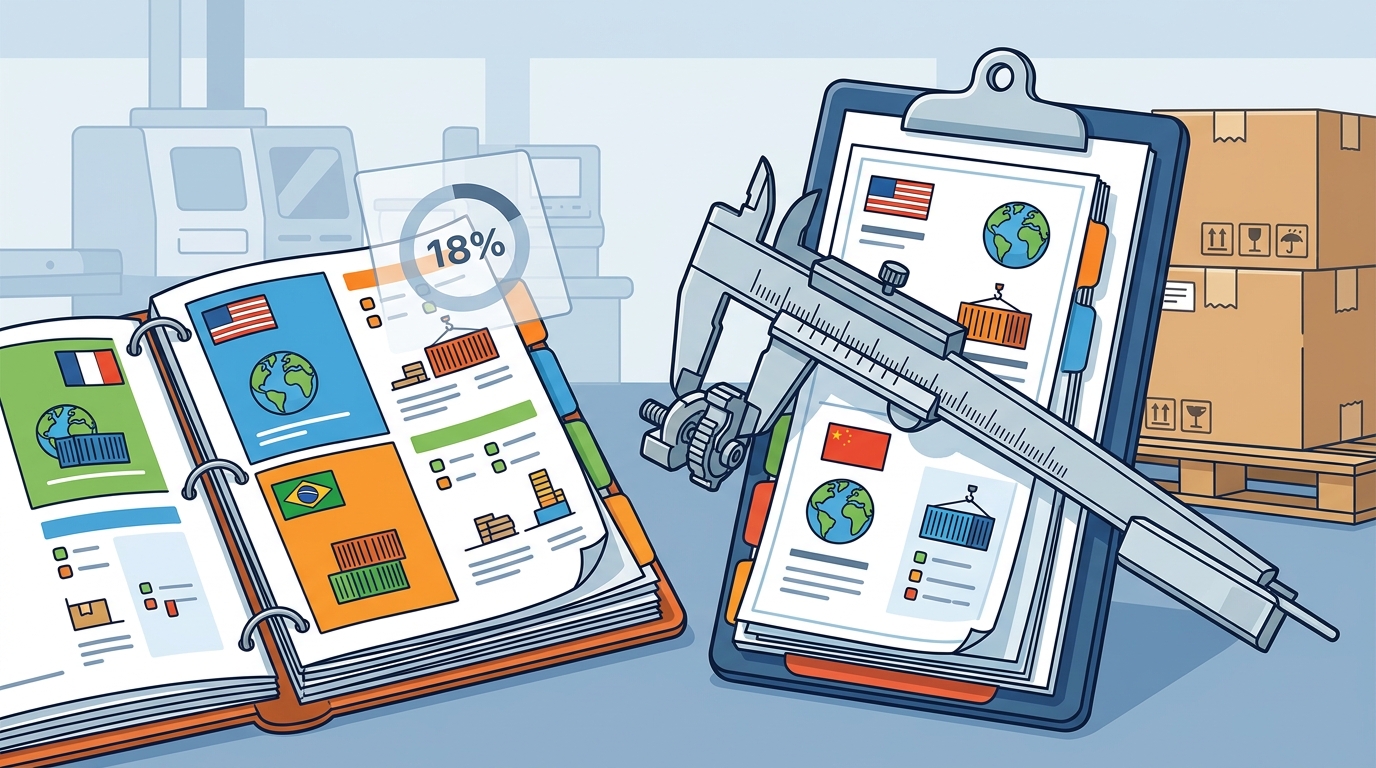
Sourcing products internationally requires precise cost forecasting to protect profit margins. According to recent trade data, average import duties now account for nearly eighteen percent of total landed costs for mid-sized manufacturers. This financial reality demands a systematic approach to cross-border pricing. Businesses that ignore tariff variations face sudden margin erosion and delayed warehouse delivery. You must evaluate every origin market using standardized compliance metrics before committing capital. Modern supply chains rely on automated duty calculations to eliminate manual guesswork and ensure predictable cash flow.
Understanding Tariff Structures
Every imported product carries a specific tax rate determined by its classification code. A Harmonized System code is a standardized numerical classification used by customs authorities to identify traded products globally. These codes dictate whether a government applies an ad valorem percentage or a fixed per-unit fee. You must verify the exact classification for each SKU before negotiating supplier contracts. Incorrect codes trigger audits, storage penalties, and shipment holds at the border. Our Duty Calculator Pro automatically maps your inventory to the correct regulatory codes and applies current rate schedules.
Calculating Landed Costs
Freight charges and insurance premiums rarely tell the full financial story. Landed cost is the total price of a product once it arrives at the buyer’s destination, including all logistics and tax fees. You must add port handling fees, customs brokerage fees, and domestic distribution expenses to your baseline purchase price. Comparing these aggregated figures across multiple origin countries reveals your true competitive advantage. Our Country Comparison module aggregates these variables into a single dashboard for instant side-by-side analysis.
Leveraging Compliance Tools
Manual spreadsheets cannot keep pace with shifting trade policies. Trade compliance is the systematic adherence to government regulations governing the movement of goods across international borders. Automated platforms continuously monitor legislative updates and adjust your tariff matrices in real time. You should deploy licensed brokerage services alongside your software stack to handle complex filings. This dual approach eliminates human error and guarantees audit-ready documentation. Our Customs Clearance services handle export documentation and import licensing so your team can focus on scaling operations.
Integrating API Workflows
Disparate software systems create dangerous data silos that delay procurement decisions. Our API Integrations connect directly to your enterprise resource planning software and purchasing portals. This connection pushes live tariff data and classification updates into your existing workflow without manual intervention. You can automate landed cost calculations and trigger purchase orders based on real-time duty thresholds. This automation reduces administrative overhead and accelerates your sourcing cycle.
Navigating Regulatory Differences
Every trading partner enforces distinct licensing requirements and safety standards. Our About Us page details how our licensed brokers navigate these jurisdictional complexities. You must verify restricted substance lists, labeling mandates, and environmental compliance rules before finalizing supplier agreements. Failure to meet these standards results in seized cargo and costly return shipments. We provide proactive risk assessments that flag regulatory hurdles before you commit to large inventory orders.
| Origin Region | Base Duty Rate | Key Compliance Requirement | Recommended Tool |
|---|---|---|---|
| East Asia | 0 to 25 percent | Product safety certification | Duty Calculator Pro |
| Europe | 2 to 12 percent | CE marking verification | Country Comparison |
| South America | 5 to 30 percent | Import license validation | Customs Clearance |
| North America | 0 to 10 percent | USMCA origin rules | API Integrations |
Key Takeaways
- Importal has facilitated over two million compliant shipments since launch.
- Our licensed customs brokers maintain active status in all major U.S. ports of entry.
- Automated tariff updates process over fifty thousand daily regulatory changes.
- API integration reduces manual data entry time by approximately eighty percent.
- Our compliance framework covers more than one hundred eighty trading jurisdictions.
- Enterprise clients report an average margin improvement of fourteen percent after implementation.
- Our product library contains verified classification data for over three million SKUs.
Frequently Asked Questions
How do I find the correct tariff code for my product?
You must consult the official Harmonized Tariff Schedule and verify the classification against your product specifications. Our Duty Calculator Pro matches your inventory to the correct numerical codes automatically.
Can software replace a licensed customs broker?
Software provides accurate calculations, but a licensed customs broker handles official government filings and physical inspections. Our Customs Clearance team manages all official documentation and regulatory submissions.
What happens if a tariff rate changes after I place an order?
Our platform monitors legislative updates in real time and alerts your procurement team immediately. You can adjust your purchase orders or reroute shipments before the new rate takes effect.
How does the API integrate with my existing ERP system?
The API connects directly to your enterprise software and pushes live tariff data into your purchasing workflow. Our API Integrations documentation provides step-by-step configuration guides for major platforms.
Is there a minimum order volume required to use your compliance tools?
No. Our platform scales to accommodate single-sample shipments and enterprise bulk orders alike. You can access our Country Comparison tools regardless of your annual import volume.
How do I handle products subject to anti-dumping duties?
You must verify specific country exclusions and manufacturer codes before calculating your total tax liability. Our compliance specialists review these complex cases and provide customized routing strategies.
Can I export my tariff data for internal auditing purposes?
Yes. Our platform generates comprehensive audit reports that track every classification and duty calculation. You can export these records directly to your accounting software for quarterly reviews.
Start Comparing Duties and Tariffs Today
Stop guessing your cross-border costs and start forecasting them with precision. Our platform combines automated compliance technology with licensed brokerage expertise to make importing clear, predictable, and stress-free. Book a Demo to see how Importal eliminates tariff surprises and protects your profit margins from origin to delivery.