

Common Mistakes When Comparing Duties and Tariffs Across Sourcing Countries
Global supply chains are currently navigating a period of unprecedented volatility in trade policy. According to the World Trade Organization, the complexity of non-tariff barriers and shifting tariff regimes has increased the operational burden on importers by over 40 percent in recent years. Many procurement teams still rely on static spreadsheets that fail to account for real-time regulatory changes, leading to significant margin erosion. This guide details the critical errors that undermine accurate landed cost calculations and provides a framework for precise duty comparison.
Understanding the Basics of Duty vs. Tariff
Before diving into comparative analysis, it is essential to distinguish between two frequently confused terms. Tariff is a tax imposed by a government on imported goods. These taxes are designed to protect domestic industries or generate revenue for the state. Duty is the actual amount of tax paid on a specific shipment. While often used interchangeably in casual conversation, duty is the calculated financial liability, whereas tariff is the regulatory framework.
When comparing sourcing countries, you are essentially comparing the total duty liability against the unit cost of goods. A lower unit price in Country A may be offset by a higher duty rate in Country B. Accurate comparison requires looking at the final landed cost, not just the invoice price. This holistic view prevents costly surprises at the border and ensures that your profit margins remain intact.
HTS Classification Errors
The most common mistake in duty comparison is using incorrect Harmonized Tariff Schedule (HTS) codes. An HTS code determines the specific duty rate applied to your product. Misclassifying a product can lead to underpayment or overpayment of duties, both of which carry severe risks.
The Cost of Misclassification
If you classify a product under a code with a lower duty rate, Customs and Border Protection (CBP) may audit your records and demand back payments plus penalties. Conversely, using a code with a higher rate unnecessarily inflates your costs. According to U.S. Customs and Border Protection, accurate classification is the importer's legal responsibility. This means you cannot blame a supplier for an error if you did not verify the HTS code yourself.
Dynamic Classification Tools
Static classification lists become outdated quickly. Trade agreements and tariff exclusions change frequently. Using a dynamic tool that updates HTS codes in real-time ensures that you are always comparing the most current duty rates. This is particularly important when evaluating products with complex components or mixed materials.
Ignoring Rules of Origin
Rules of Origin determine the national source of a product for tariff purposes. Many importers make the mistake of assuming that the country of manufacture is the country of origin. This is often incorrect. If a product is assembled in one country but uses components from another, the origin may be different.
Free Trade Agreements (FTAs)
FTAs like USMCA or various bilateral agreements can reduce duties to zero. However, these benefits only apply if the product meets specific origin criteria. Failing to verify these criteria before sourcing leads to missed savings. You must ensure that the supplier can provide the necessary documentation to prove origin status.
De Minimis Thresholds
Another critical factor is the de minimis threshold. This is the value below which imports enter a country duty-free. For the U.S., this is currently $800. When comparing countries, consider whether your shipment volume qualifies for this exemption. Shipping smaller parcels from one country might be more cost-effective than bulk shipping from another due to these thresholds.
Overlooking Hidden Fees and Surcharges
Duties are only one part of the import cost. Many importers fail to account for additional fees that vary by country and port of entry. These include merchandise processing fees (MPF), harbor maintenance fees, and anti-dumping duties.
Anti-Dumping and Countervailing Duties
Anti-dumping duties are imposed on imports that are sold below fair market value. These rates can be extremely high and are specific to the country and manufacturer. If you source from a country with a history of anti-dumping cases for your product category, the duty comparison will be skewed significantly. Always check for existing trade remedies before finalizing a sourcing decision.
Logistics and Handling Costs
Different countries have varying logistics infrastructures. A country with lower duties might have higher shipping costs or longer transit times. These factors impact your working capital and inventory turnover. A comprehensive comparison must include the total cost of ownership, including logistics, insurance, and handling.
The Technology Gap in Compliance
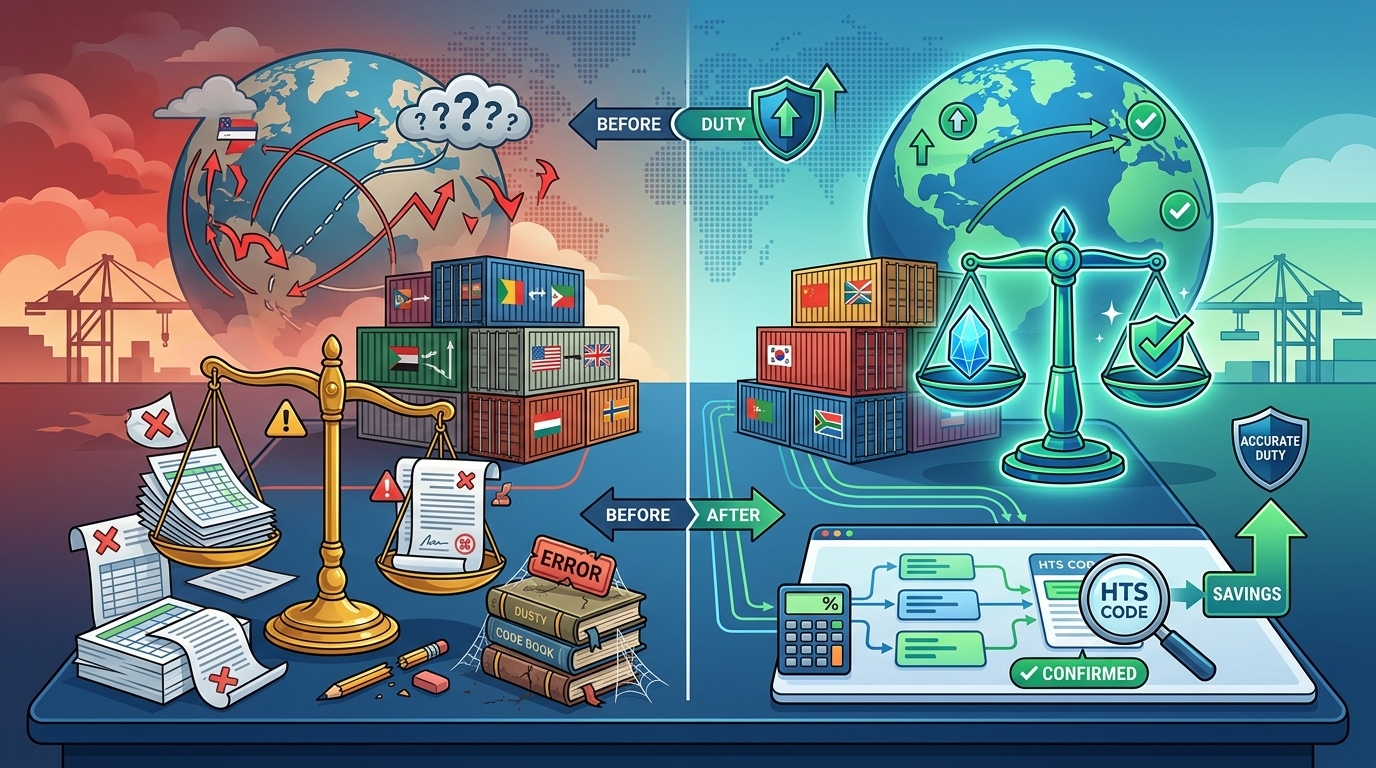
Manual comparison of duties across multiple countries is prone to human error and is incredibly time-consuming. Many companies still rely on Excel spreadsheets that are not updated in real-time. This approach is unsustainable in a fast-changing trade environment.
Automated Duty Calculations
Using an automated platform like Importal's Duty Calculator Pro allows you to simulate landed costs instantly. These tools pull live tariff data and apply it to your specific product details. This eliminates the guesswork and provides a clear, accurate comparison of duties across different sourcing options.
API Integration for Scale
For larger enterprises, manual entry is not feasible. Importal's API integrates directly with your ERP or purchasing systems. This ensures that duty calculations are part of the procurement workflow, not an afterthought. Real-time data feeds allow you to make sourcing decisions based on the most current trade regulations.
Strategic Sourcing Comparison
The following table illustrates how different factors impact duty comparison across common sourcing regions. Note that specific rates vary by product and trade agreement.
| Sourcing Region | Typical Duty Risk | Key Compliance Factor | Recommended Tool |
|---|---|---|---|
| China | High (Section 301 tariffs) | HTS Code Accuracy | Duty Calculator Pro |
| Vietnam | Medium (FTAs available) | Rules of Origin | Country Comparison |
| Mexico | Low (USMCA benefits) | Regional Value Content | API Integration |
| India | Variable (Bilateral deals) | Customs Clearance | Import Services |
Key Takeaways
- HTS Codes are Dynamic: Always verify HTS codes using a live database, not a static list.
- Origin Matters: Rules of Origin can reduce duties to zero, but require strict documentation.
- Total Landed Cost: Compare duties, shipping, and handling together, not in isolation.
- Technology is Essential: Manual spreadsheets lead to errors; use automated tools for accuracy.
- Anti-Dumping Risks: Check for trade remedies in your specific product category before sourcing.
- De Minimis Opportunities: Leverage the $800 threshold for smaller shipments where applicable.
- Expert Support: Partner with licensed customs brokers for complex clearance needs.
Frequently Asked Questions
What is the difference between a tariff and a duty?
A tariff is the tax rate imposed by a government, while duty is the actual amount paid based on that rate and the value of the goods.
How do I determine the correct HTS code for my product?
You can use a duty calculator tool to find the correct HTS code based on your product's description and composition. Consulting a licensed customs broker is also recommended.
Can I avoid duties by shipping from a different country?
Yes, if the new country has a favorable trade agreement or lower tariff rates. However, you must ensure the Rules of Origin are met to qualify for these benefits.
What are anti-dumping duties?
Anti-dumping duties are additional tariffs imposed on imports sold below fair market value. They are specific to the country and manufacturer.
How often do tariff rates change?
Tariff rates can change frequently due to trade agreements, policy updates, and geopolitical events. Using a real-time data source is crucial for accuracy.
What is the de minimis threshold for the U.S.?
The U.S. de minimis threshold is $800. Imports valued below this amount can enter the country duty-free under Section 321.
Why is automated duty calculation important?
Automated tools provide real-time accuracy, reduce human error, and save time by integrating directly with your procurement systems.
How can Importal help with duty comparison?
Importal offers tools like Duty Calculator Pro and Country Comparison to help you analyze landed costs and identify the most cost-effective sourcing options.
Start Optimizing Your Imports
Stop guessing your landed costs and start making data-driven sourcing decisions. Importal provides the AI-powered tools and expert brokerage services you need to navigate complex trade regulations with confidence. Sign up for a free trial today and see how much you can save by comparing duties accurately across your global supply chain.