

What's included in my total landed cost when sourcing from different countries?
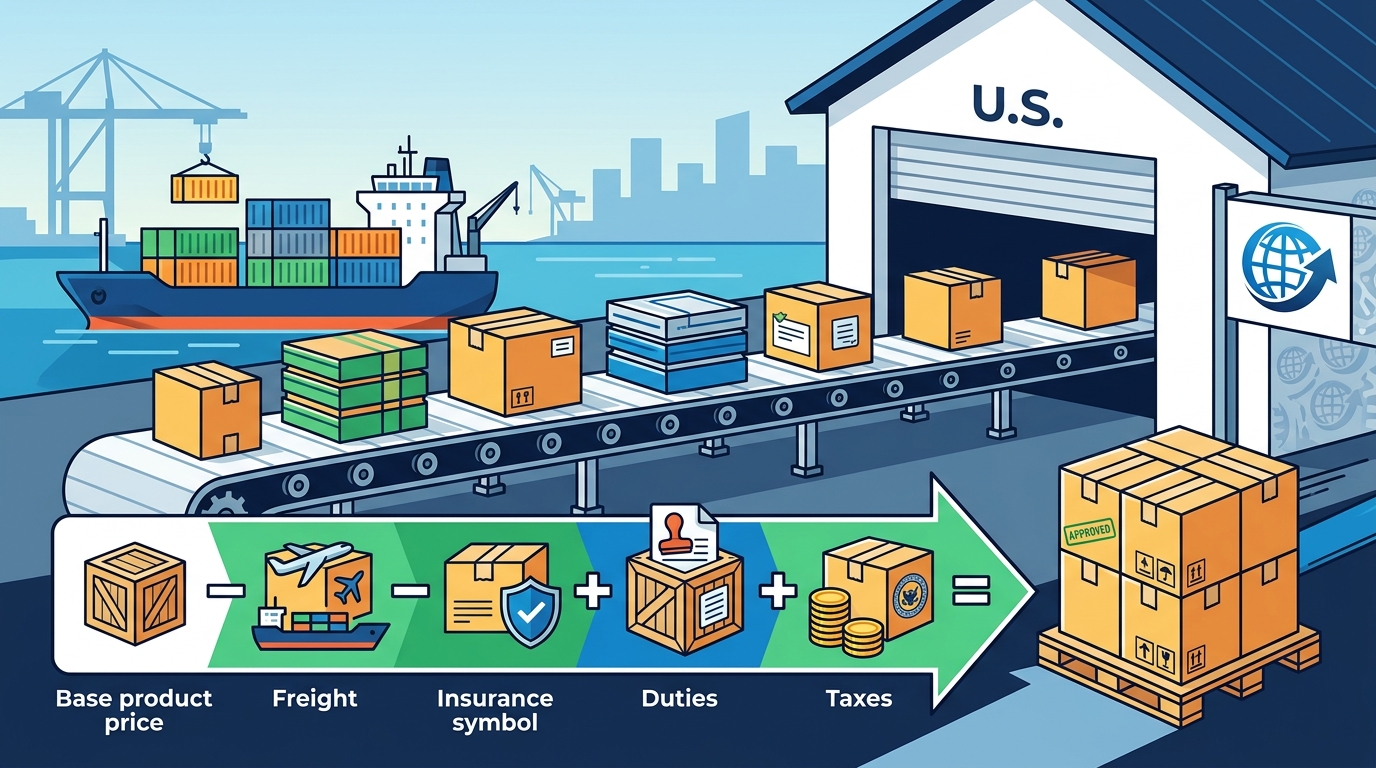
Total landed cost is the sum of the product price, freight, insurance, duties, and taxes required to move goods from a foreign supplier to your U.S. warehouse. It is the true cost of inventory before it reaches your shelf. Importal helps importers calculate this figure accurately by integrating live tariff data directly into their purchasing workflows.
The Core Components of Landed Cost
Understanding the anatomy of landed cost is the first step to protecting your margins. The base price of the goods is only the starting point. You must also account for the cost of moving those goods across borders. This includes international freight charges, which vary significantly depending on the shipping method and origin country.
Import duties are the most variable component in this equation. A duty is a tax imposed by the government on imported goods. The rate depends on the Harmonized Tariff Schedule (HTS) classification of the product and its country of origin. For example, a steel product from one country may face a significantly higher duty rate than the same product from a country with a free trade agreement. Importal’s Duty Calculator Pro provides instant lookups across over 100,000 HTS codes to ensure you are using the correct rate.
Hidden Fees and Regulatory Costs
Many importers underestimate the regulatory costs associated with bringing goods into the United States. These are often overlooked until a shipment is held at the border. Customs brokerage fees are required to file the entry with U.S. Customs and Border Protection (CBP). Additionally, you may need to secure an import bond, which acts as a guarantee that duties will be paid.
Partner Government Agency (PGA) requirements can also add complexity and cost. If your product falls under the jurisdiction of agencies like the FDA or EPA, you may need to pay for testing, certification, or additional documentation. Importal’s platform identifies these PGA requirements instantly, allowing you to budget for them before you ship. This prevents the costly delays that occur when a shipment is flagged for missing compliance documentation.
Freight, Insurance, and Logistics
Logistics costs are a major driver of landed cost variance between sourcing countries. The distance from the supplier to your U.S. port of entry directly impacts freight rates. Ocean freight is generally cheaper per unit but slower, while air freight is faster but significantly more expensive. You must also consider the cost of inland transportation from the port to your final destination.
Marine insurance is another critical line item. It protects your inventory against loss or damage during transit. While the premium is a small percentage of the cargo value, it is a necessary expense for risk management. By using Importal’s Country Comparison tool, you can view these costs side-by-side for different sourcing regions. This allows you to see the total cost impact of choosing a supplier in Southeast Asia versus North America.
Automating Landed Cost Calculations
Manual calculation of landed cost is prone to error and becomes unmanageable at scale. Spreadsheets cannot keep up with daily tariff updates or complex trade rules. When a new trade agreement is signed or a tariff exclusion is granted, manual systems often fail to reflect these changes in time. This leads to inaccurate budgeting and unexpected cash flow issues.
Importal’s API plugs directly into your ERP or purchasing system to automate these calculations in real-time. As trade rules change, your systems update automatically. This ensures that your landed cost figures are always current. For teams managing large catalogs, this automation is essential. It allows you to fetch live tariff rates and calculate accurate landed costs automatically as purchase orders are created. You can learn more about how to set up the API to integrate with your existing tech stack.
Strategic Sourcing and Margin Protection
Accurate landed cost data enables smarter sourcing decisions. When you know the true cost of goods from different countries, you can identify the most cost-effective suppliers. This is not just about finding the cheapest product price. It is about finding the lowest total cost of ownership. A slightly higher product price from a country with lower duties and shorter freight times may result in a lower total landed cost than a cheaper product from a high-tariff region.
Importal helps you find these cost-saving opportunities through trade agreements and tariff exclusions. By analyzing your product data against current trade measures, the platform highlights where you can reduce your duty exposure. This turns tariff complexity into a competitive advantage. You can also explore the Product Library to keep your catalog classifications aligned and up-to-date.
Key Takeaways
- Total landed cost includes product price, freight, insurance, duties, and regulatory fees.
- Import duties vary by HTS code and country of origin, making them the most volatile cost component.
- Partner Government Agency (PGA) requirements can add hidden costs and delays if not identified early.
- Manual calculation methods are error-prone and cannot keep pace with daily tariff updates.
- Automating landed cost calculations via API ensures real-time accuracy in your ERP system.
- Comparing landed costs across countries helps identify the most cost-effective sourcing locations.
- Importal provides the tools to calculate, track, and optimize landed costs for importers.
Frequently Asked Questions
What is the difference between product price and landed cost?
Product price is what you pay the supplier for the goods. Landed cost is the total cost to get those goods to your warehouse, including freight, duties, insurance, and fees.
How often do tariff rates change?
Tariff rates can change daily due to new trade agreements, exclusions, or enforcement actions. Importal monitors these changes continuously to keep your data current.
Do I need an import bond for every shipment?
Most importers need a bond to clear goods. A single bond covers one shipment, while a continuous bond covers multiple shipments over a year. Importal can help you secure the right bond.
Can I calculate landed cost before I buy the goods?
Yes. Importal is designed to be used before goods are purchased. You can calculate estimated landed costs during sourcing and vendor negotiations to understand your true investment.
What is an HTS code?
An HTS code is a standardized number used to classify products for customs purposes. It determines the duty rate and any regulatory requirements for the product.
How does Importal handle PGA requirements?
Importal’s platform instantly identifies FDA, EPA, USDA, and other Partner Government Agency requirements for your products, so you know what you need before you ship.
Start Calculating with Confidence
Accurate landed cost calculation is the foundation of profitable importing. It allows you to make data-driven sourcing decisions and protect your margins from unexpected fees. Importal provides the technology and expertise you need to navigate this complexity. Our team of licensed customs brokers and compliance specialists is dedicated to making importing simpler, safer, and more predictable. To plan your next shipment, to see how Importal can streamline your trade compliance workflow.