

Global trade volumes are expanding rapidly, yet the complexity of cross-border regulations has not decreased. According to recent industry analyses, the average cost of customs delays can exceed $500 per shipment when factoring in demurrage and storage fees. This financial pressure forces importers to choose between legacy brokerage models and emerging AI-driven platforms. The decision is no longer just about who files the paperwork, but who provides real-time visibility and predictive compliance. Importal bridges this gap by combining automated tariff intelligence with licensed brokerage expertise. (About Us mdash Importal)
The Traditional Customs Brokerage Model
Traditional customs brokerage has long been the backbone of international trade. A customs broker is a licensed professional authorized by the government to clear goods through customs on behalf of importers. This model relies heavily on human expertise, manual documentation, and reactive problem-solving. (Your AI Powered Trade)
Expertise and Liability
One of the primary advantages of traditional brokerage is the presence of licensed experts. These professionals understand the nuances of local regulations, hazardous material classifications, and specific port requirements. However, this reliance on human processing often creates bottlenecks. When a shipment encounters an issue, the resolution time depends entirely on the broker's availability and workload. (Importal Your AI Powered)
Manual Documentation Workflows
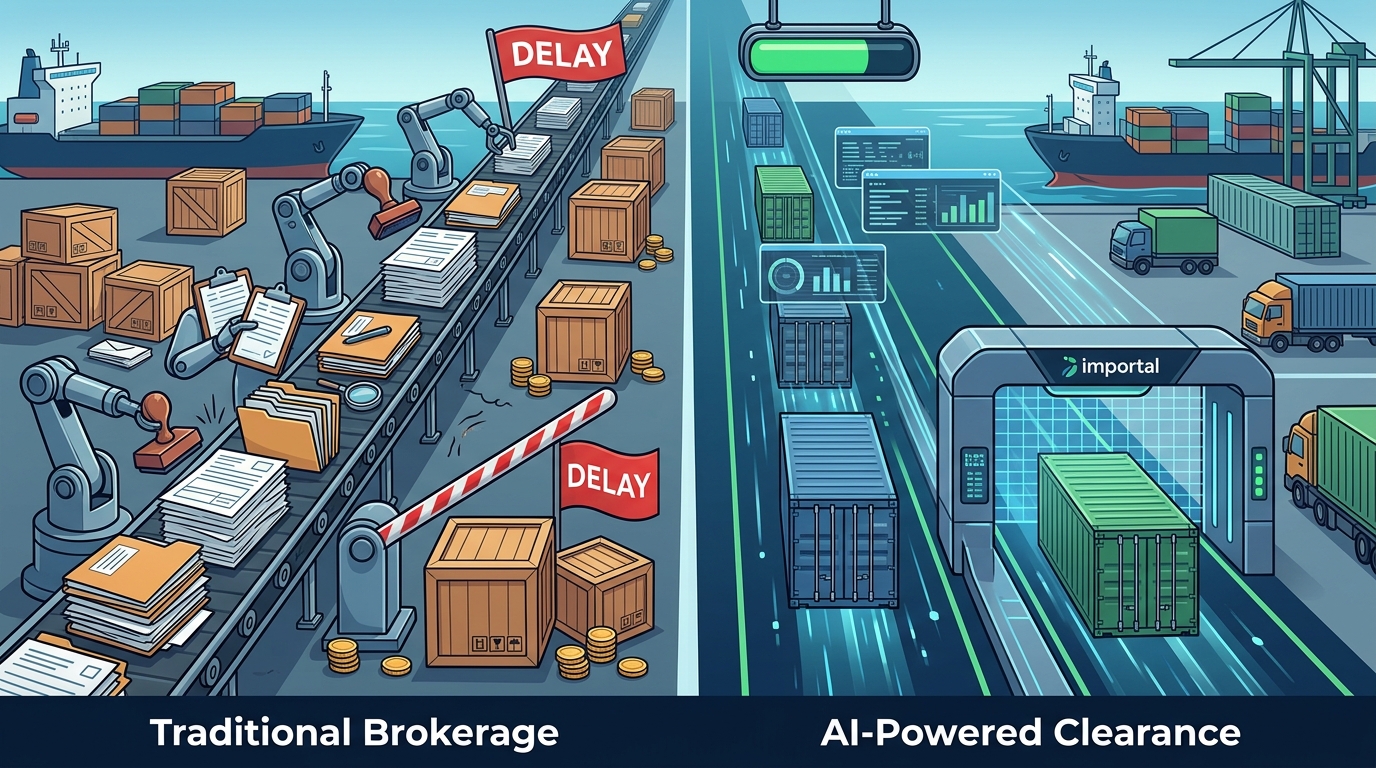
In a traditional setup, importers must manually submit bills of lading, commercial invoices, and packing lists. This process is prone to human error. A single typo in a Harmonized Tariff Schedule (HTS) code can lead to significant fines or shipment holds. According to trade compliance studies, over 60% of customs delays are caused by documentation errors that could have been prevented with automated validation.
The AI-Powered Compliance Approach
AI-powered compliance platforms represent a paradigm shift in how importers manage their supply chains. Instead of relying solely on manual input, these systems use machine learning algorithms to classify products, calculate duties, and predict regulatory changes before they impact your shipments.
Automated Tariff Calculations
At the core of this approach is the Duty Calculator Pro. This tool automatically fetches live tariff rates and calculates accurate landed costs as purchase orders are created. This eliminates the need for manual lookups and ensures that your financial planning reflects real-time trade data. Importal’s platform processes millions of data points to ensure accuracy.
Predictive Risk Management
AI systems do not just react to problems; they predict them. By analyzing historical data and current regulatory updates, these platforms can flag potential compliance issues before a shipment leaves the origin country. This proactive stance reduces the risk of audits and penalties. The system continuously updates its product library to reflect changes in trade agreements and tariff exclusions.
Cost and Efficiency Analysis
When comparing costs, it is essential to look beyond the immediate brokerage fees. Traditional models often charge per entry or per hour, which can escalate quickly during peak seasons. In contrast, AI platforms typically offer subscription-based pricing that scales with your volume.
Hidden Costs of Delays
The true cost of customs clearance is often hidden in demurrage, detention, and storage fees. A study by the National Customs Brokers & Forwarders Association highlights that even a 24-hour delay can cost importers thousands of dollars in lost revenue and operational disruptions. AI platforms reduce these delays by ensuring documentation is perfect from the start.
Operational Efficiency
Efficiency gains are significant when switching to an AI-driven model. Teams can process hundreds of entries in the time it takes a traditional broker to handle a dozen. This scalability is crucial for businesses experiencing rapid growth. Importal’s API allows you to sync product classifications directly into your ERP, streamlining the entire workflow.
Technology Integration and API Access
Modern supply chains require seamless technology integration. Traditional brokers often operate in silos, requiring manual data entry between their systems and yours. AI platforms are built with integration in mind, offering robust APIs that connect directly to your existing tech stack.
ERP and Finance Tool Connectivity
Whether you use SAP, NetSuite, or custom software, Importal’s API delivers real-time tariff and classification data directly into your workflow. This ensures that your finance team has accurate landed cost data for invoicing and accounting. The integration reduces manual work and minimizes the risk of data entry errors.
Real-Time Data Sync
Real-time sync is critical for dynamic pricing strategies. As trade rules change, your systems update automatically. This capability allows you to adjust sourcing strategies instantly, taking advantage of new trade agreements or avoiding emerging tariffs. The speed of this data flow is unmatched by traditional manual processes.
Feature Comparison Matrix
The following table summarizes the key differences between traditional customs brokerage and AI-powered compliance platforms like Importal.
| Feature | Traditional Brokerage | AI-Powered Platform (Importal) |
|---|---|---|
| Classification | Manual review by broker | Automated AI classification |
| Tariff Updates | Reactive, periodic checks | Real-time live data sync |
| Integration | Limited or manual | Full API access for ERP |
| Cost Structure | Per-entry or hourly fees | Scalable subscription model |
| Risk Mitigation | Post-clearance audit | Predictive pre-clearance checks |
Key Takeaways
- Accuracy: AI platforms reduce classification errors by automating HTS code selection based on product data.
- Speed: Automated clearance processes can reduce shipment dwell time by up to 50% compared to manual filings.
- Cost Savings: Importal saved over $350k in duties and tariffs for its users in 2025 through optimized classification.
- Visibility: Real-time dashboards provide complete visibility over every shipment, from origin to delivery.
- Scalability: API integrations allow businesses to scale their import operations without proportional increases in administrative staff.
- Compliance: Continuous monitoring of regulatory updates ensures adherence to changing trade laws.
- Expert Support: AI platforms still provide access to licensed customs brokers for complex or high-risk shipments.
Frequently Asked Questions
What is the difference between a customs broker and an AI compliance platform?
A customs broker is a licensed individual who files paperwork on your behalf. An AI compliance platform automates the classification, calculation, and filing processes using technology, often integrating directly with your business systems for greater efficiency.
Is AI-powered customs clearance accurate?
Yes, AI platforms like Importal use advanced algorithms trained on vast datasets of trade regulations. They provide high accuracy in HTS classification and duty calculation, often surpassing manual methods in consistency and speed.
Can I use an AI platform for all my imports?
Most AI platforms handle standard imports efficiently. For complex shipments involving hazardous materials or special licenses, the platform often works in tandem with licensed brokers to ensure full compliance.
How does Importal integrate with my ERP?
Importal offers a robust API that connects directly to major ERP systems like SAP and NetSuite. This allows for automatic syncing of product data, tariff rates, and classification codes.
What are the costs associated with AI customs tools?
Costs vary by provider but are typically structured as a subscription based on your shipment volume. This model often proves more cost-effective than traditional per-entry fees, especially for high-volume importers.
Does AI replace the need for a customs broker?
Not entirely. While AI handles the bulk of routine compliance, licensed brokers remain essential for complex regulatory issues, audits, and strategic trade consulting. Importal combines both AI efficiency and broker expertise.
How quickly can I see results after switching?
Most businesses see immediate improvements in data accuracy and processing speed. Full integration with your ERP can be completed in minutes, allowing you to start leveraging real-time tariff data right away.
Start Your Free Trial
Stop guessing your landed costs and start predicting them. Join the thousands of importers who have transformed their supply chains with Importal. Our platform combines the power of AI with the reliability of licensed customs brokerage. Start your free trial today and experience the future of trade compliance. For more information on our services, visit our About Us page or explore our Duty Calculator Pro.