

Common Integration Mistakes When Connecting Trade Compliance Software to ERP Systems
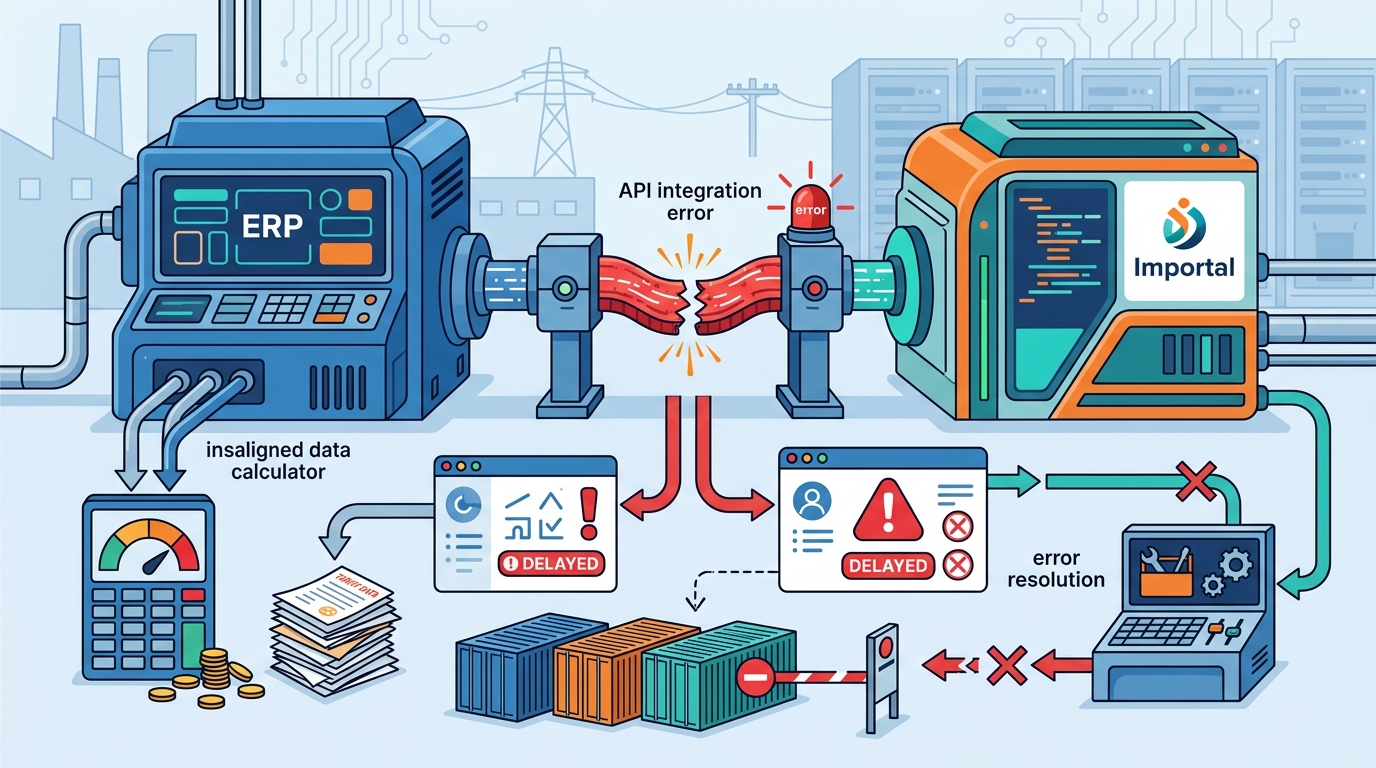
Seamless data flow between your Enterprise Resource Planning (ERP) system and trade compliance tools is the backbone of modern supply chain efficiency. According to recent industry analyses, API integration errors account for nearly 30% of delayed customs clearances in mid-sized enterprises. When tariff data fails to sync, landed costs become inaccurate, leading to budget overruns and compliance violations. This guide details the critical technical and operational pitfalls to avoid when linking your ERP to a robust compliance platform.
Data Synchronization and Latency Issues
One of the most frequent technical failures occurs when ERP systems push purchase order data to compliance engines without real-time validation. If your system relies on batch processing rather than live API calls, you risk using outdated tariff rates. Trade regulations change frequently, and static data caches can lead to significant financial discrepancies. (About Us mdash Importal)
Importal’s API is designed to plug directly into your ERP, purchasing system, or custom tools to automate tariff calculations in real-time. This ensures that no manual lookups are required and that compliance surprises are eliminated before they impact your bottom line. Stream tariff updates automatically to keep your workflow aligned with current U.S. Customs and Border Protection (CBP) requirements.
The Cost of Stale Data
When classification data is not updated instantly, your system may apply incorrect duty rates. This leads to underpayment or overpayment of tariffs. Over time, these small errors compound into substantial financial losses. Real-time synchronization ensures that your landed cost calculations reflect the exact moment of purchase order creation.
HTS Code Misalignment
The Harmonized Tariff Schedule (HTS) is a complex framework used to classify goods for importation. A common mistake is assuming that the HTS code in your ERP matches the code required by the destination country’s customs authority. These codes often differ based on material composition, usage, and manufacturing origin.
HTS classification is the systematic categorization of goods to determine applicable duties and taxes. Without automated verification, your ERP may store legacy codes that no longer apply to your current product lines. Importal maintains a product library covering over 20,000 codes, ensuring that your ERP syncs with the most accurate and current classification data available.
Automating Classification Updates
Manual entry of HTS codes is prone to human error. By integrating a dynamic classification engine, you allow your ERP to fetch live updates. This reduces the risk of misclassification penalties and ensures that your compliance team can focus on strategic sourcing rather than data entry.
Inadequate Error Handling Protocols
APIs are not infallible. Network interruptions, server downtime, or malformed data payloads can cause integration failures. Many organizations fail to implement robust error handling, leading to silent failures where data is lost without notification. This lack of visibility can halt shipments and disrupt supply chains.
Effective error handling requires immediate alerts and retry mechanisms. When an API call fails, your system should log the error, notify the compliance team, and attempt to resolve the issue automatically. Importal’s API infrastructure is built for scale and accuracy, providing reliable status updates and clear error codes to help you troubleshoot issues quickly.
Monitoring API Health
Regular monitoring of API health is essential for maintaining compliance. Use dashboards to track success rates, latency, and error frequencies. This proactive approach allows you to identify and resolve issues before they impact your import operations. Explore our knowledge hub for best practices on monitoring and maintaining your integration.
Security and Compliance Gaps
Trade compliance data includes sensitive information about your supply chain, suppliers, and costs. Ensuring the security of this data during transmission and storage is paramount. Many organizations overlook the importance of encryption and access controls in their integration architecture.
AICPA SOC 2 certification is a critical standard for data security and privacy. Importal is AICPA SOC 2 Certified, ensuring that your data is protected against unauthorized access and breaches. When choosing a compliance partner, verify their security credentials to ensure they meet your organization’s risk management standards.
Implementing Secure Authentication
Use OAuth 2.0 or API keys with strict scope limitations to secure your integration. Regularly rotate credentials and audit access logs to detect any suspicious activity. This layered security approach protects your data and maintains trust with your partners and customers.
Insufficient Testing Environments
Deploying an integration directly to production without thorough testing is a recipe for disaster. Many teams skip the staging phase, leading to unexpected errors when live data flows through the system. A robust testing environment allows you to simulate various scenarios and validate data integrity before going live.
Importal provides a sandbox environment for testing your API integrations. Use this space to validate your data mappings, test error handling, and ensure that your ERP correctly interprets the compliance data. This step is crucial for identifying and resolving issues before they impact your real-world operations.
Validation Checklists
Create a comprehensive validation checklist that includes data format verification, tariff rate accuracy, and compliance flagging. Use this checklist to guide your testing process and ensure that all aspects of the integration are functioning as expected.
ERP Integration Options
Choosing the right integration method depends on your ERP’s capabilities and your organization’s technical resources. Below is a comparison of common integration approaches.
| Integration Method | Complexity | Real-Time Capability | Best For |
|---|---|---|---|
| REST API | Medium | High | Custom ERPs and modern tech stacks |
| EDI (Electronic Data Interchange) | High | Low | Legacy systems and large enterprises |
| CSV Upload | Low | None | Small businesses with low volume |
| Middleware Solutions | Medium | Medium | Complex multi-system environments |
Key Takeaways
- API integration errors are a leading cause of customs delays, affecting nearly 30% of mid-sized enterprises.
- Real-time synchronization is essential for accurate landed cost calculations and compliance.
- HTS codes must be dynamically updated to reflect current trade regulations and product specifications.
- Robust error handling and monitoring are critical for maintaining supply chain visibility.
- SOC 2 certification ensures that your trade data is protected against security breaches.
- Testing in a sandbox environment prevents costly production errors.
- Importal’s API saves importers an average of $350,000 in duties and tariffs annually.
Frequently Asked Questions
How does Importal ensure data accuracy in ERP integrations?
Importal uses real-time API calls to fetch live tariff data and classifications, ensuring that your ERP always has the most current information. This eliminates the risk of using stale data and ensures accurate landed cost calculations.
What is the difference between EDI and API integration for trade compliance?
EDI is a batch-based protocol often used in legacy systems, while API integration allows for real-time, bidirectional data exchange. APIs are generally faster and more flexible, making them ideal for modern ERP systems.
Can I test the integration before going live?
Yes, Importal provides a sandbox environment for testing. You can validate your data mappings, test error handling, and ensure that your ERP correctly interprets the compliance data before deploying to production.
How does Importal handle HTS code updates?
Importal’s product library is continuously updated to reflect changes in the Harmonized Tariff Schedule. Your ERP syncs with this library in real-time, ensuring that your classifications are always accurate.
Is Importal’s API secure?
Yes, Importal is AICPA SOC 2 Certified, ensuring that your data is protected against unauthorized access and breaches. We use industry-standard encryption and authentication protocols to secure your data.
What are the common causes of API integration failures?
Common causes include network interruptions, malformed data payloads, and outdated API versions. Implementing robust error handling and monitoring can help mitigate these risks.
How long does it take to integrate Importal with my ERP?
Integration time varies depending on your ERP’s complexity and your technical resources. However, Importal’s API is designed for quick setup, with many teams connecting their systems in minutes.
Start Your Integration
Stop guessing your landed costs and start automating your compliance. Connect your ERP to Importal’s AI-powered platform today. Book a demo to see how our API can streamline your import operations and ensure complete visibility over duties and classifications.